Minto, “Rhymes of Early Life in Oregon, and…”
No, thankfully, this is not all doggerel…
“Rhymes of Early Life in Oregon“, subtitled “And Historical and Biographical Facts” (Salem, OR: Statesman Publishing Co, 1915) is our source today for a fairly early Settler’s remembrances.
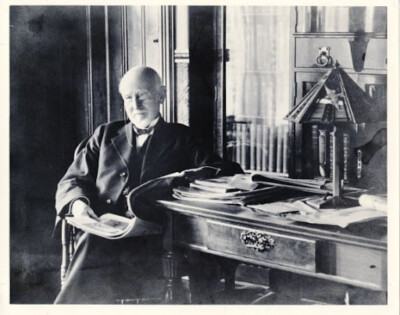
John Minto (image credit: Willamette Heritage)
This little book is by John Minto IV (1822-1915), born in England, who arrived in Oregon Territory in 1844.
Minto came here at a time when it was more or less unavoidably necessary to learn Chinuk Wawa. So he did.
Page 48 equates a couple of Indigenous-sourced words well known to Settlers (wocus & couse) with two Jargon terms:

In 1806, then, we have the
fact of a population, roughly estimated at forty thousand,
ekeing out a hand-to-mouth living, from salmon chiefly,
with the additions of wokas kouse (wapato and camas),-
the latter much the more generally distributed from the
Pacific Ocean to the summit flats of the Rocky Mountains-
by going across those mountains annually for game.
Page 51 discusses the famous Jargon-named “cold sick” epidemic:

Doctor McLoughlin instituted the first hospital in Oregon
for white people here prior to the overland immigration
of family life from the Missouri border in 1843. The
native race then were being removed rapidly by a disease
they themselves called the “cold sick,” which had raged
among them from 1832.
On pages 59-60, Chief Cullaby talks Jargon with Minto about a girl named Margaret and about having read that there was a White man many years ago who had had kids with a Native woman. (There’s also discussion of a woman said puzzlingly to have been called Ona-Clam, which would mean ‘Clam-Clam’ in Jargon);
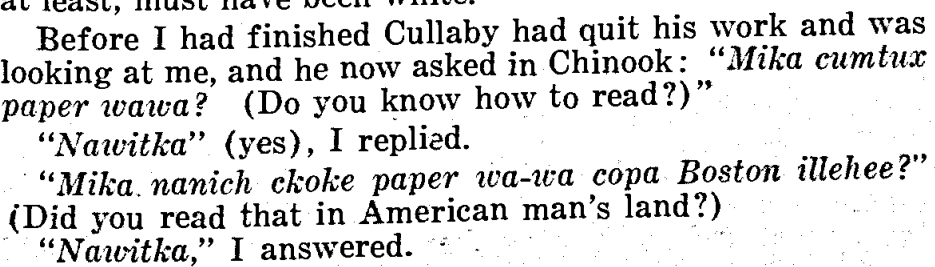

Before I had finished Cullaby had quit his work and was
looking at me, and he now asked in Chinook: “Mika cumtux
paper wawa? (Do you know how to read?)”“Nawitka” (yes), I replied.
“Mika nanich okoke paper wa-wa copa Boston illehee?“
(Did you read that in American man’s land?)“Nawitka,” I answered.
60
A Tale of the Oregon Coast
Cullaby hesitated a moment, then touched his breast with
his hand and said: “Nika papa, okoke yaka citcum tecope.“
(My father, he half white). [DDR: more like ‘My father was that one who was half white.’] He went on: “Hiak calipy
copa mu-luk, pe nika wa-wa Edwin, pe yaka wa-wa mika.“
(Hurry, take the elk meat. [More like ‘Hurry back for the elk…’] I will talk to Edwin and he will
talk to you).
Page 73: “a white stone”, a “salmon dance”:

Cullaby was then a small boy, but he remem-
bered to have heard his father tell his grandmother, Ona,
that he had seen one of the white men make fire by holding
a white stone in the sunlight. (This white stone was Cap-
tain Clark’s sunglass, which he often used to impress the
natives).
After this Ona’s son went often to visit the white men at
Fort Clatsop. He met his death at the village of Comowool
where he had gone to attend a salmon dance, and it was
never known by whom and for what reason he was killed.
The salmon dance was a kind of thanksgiving exercise which
took place just as the season for fishing began and about
the time when wild berries were ripe.
Page 74 on Minto’s scant Jargon knowledge when he first arrived in Oregon:

This was the end of Edwin’s story. It was quite long,
made so, by the difficulty under which he labored, and
although he spoke English plainer than I did at that time,
his knowledge of words and their meaning was so limited
that he had often to resort to the Chinook jargon of which
I had a limited knowledge to make himself understood.
Page 75, some quoted Chinuk Wawa:

On meeting Katata soon after, Mr. Parrish
refused to shake hands, and said to him: “I would as soon
give my hand to a wolf as to you, until you have repented
of what you have done. You have made yourself worse
than a wolf and will surely go to hell unless you do repent.”
The handshake was not an Indian custom, but it was easily
learned by them. They were quick to see that it was the
white man’s way of expressing friendship and trust.
I do not wish to express my opinion as to the wisdom of
Mr. Parrish’s talk to Chief Katata, but it so rankled in his
mind that he had gone with his five followers to test the
missionary’s courage, and I had met the party returning
disappointed. On a visit to Solomon S. Smith, Katata told
him “Parrish wake quash” (was not afraid).
Pages 79-80:

I was fifty-eight years a resident in Oregon with a fairly
ready use of the Chinook trade jargon, before I knew that
Indian mothers carefully cautioned their children against
using the names of the dead.
By the way — Chief Cullaby, a Clatsop, is not to be confused with Chief Quinaby, a Tsimikiti (Chemeketa).
Bonus fact:
Huh, you can buy a signed copy of this book!

Here’s a libk to Chinook Jarg
LikeLike