More humor in Chinuk Wawa: 1859, northern California — Conversion of an Oregonian damsel
A variation on some of the oldest PNW folkloric jokes —
(A link to lots more humor on ChinookJargon.com)

Image credit: Bruce Sussman
This slice of humor was published in California, but it came way back in the frontier period, when Chinuk Wawa was already solidly associated with life in Oregon.
Webfeet, i.e. Oregonians (at that time the Pacific Northwesterners par excellence), were known to be odd ducks, with their own ways of speaking.
Thus the code-switching in this newspaper piece:
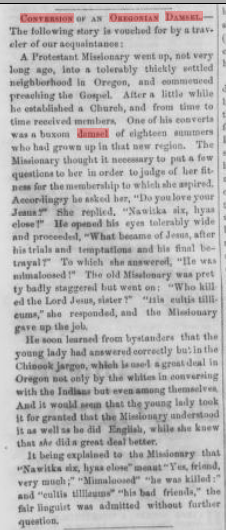
CONVERSION OF AN OREGONIAN DAMSEL
The following story is vouched for by a trav-
eler of our acquaintance:A Protestant Missionary went up, not very
long ago, Into a tolerably thickly settled
neighborhood in Oregon, and commenced
preaching the Gospel. After a little while
he established a Church, and from time to
time received members. One of his converts
was a buxom damsel of eighteen summers
who had grown up in that new region. The
Missionary thought it necessary to put a few
questions to her in order to judge of her fit-
ness for the membership to which she aspired.
Accordingly he asked her, “Do you love your
Jesus?” She replied. “Nawitka six, hyas
close!” He opened his eyes tolerably wide
and proceeded, “What became of Jesus, after
his trials and temptations and his final be-
trayal?” To which she answered, “He was
mimaloosed!” The old Missionary was pret-
ty badly staggered but went on: “Who kill-
ed the Lord Jesus, sister?” “His cultis tilli-
cums,” she responded, and the Missionary
gave up the job.He soon learned from bystanders that the
young lady had answered correctly but in the
Chinook jargon, which is used a great deal in
Oregon not only by the whites In conversing
with the Indians but even among themselves.
And it would seem that the young lady took
it for granted that the Missionary understood
it as well as he did English, while she knew
that she did a great deal better.It being explained to the Missionary that
“Nawitka six, hyas close” meant “Yes, friend,
very much;” “Mimaloosed” “he was killed:”
and “cultis tilllicums” “his bad friends,” the
fair linguist was admitted without further
question.
— from the Marysville (CA) Daily National Democrat of December 29, 1859, page 3, column 1