Pidgins are all endangered
Pidgins are by definition endangered languages. Northern Chinook Jargon is a pidgin. Pidgin languages have only, and/or primarily, adult speakers.
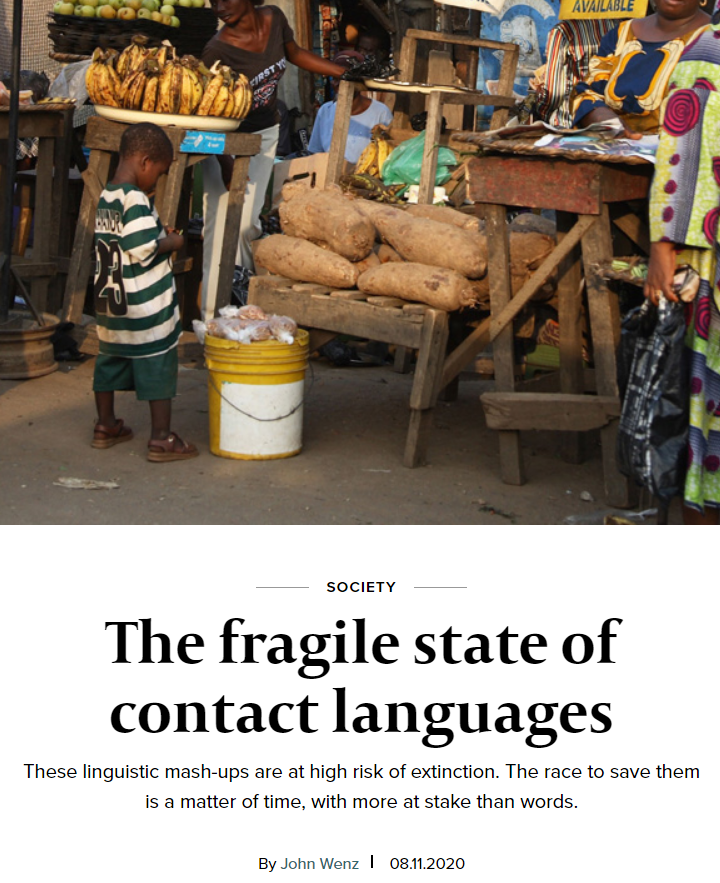
Image credit: Knowable magazine
They’re not being routinely passed along to succeeding generations of kids in the pidgin-speaking households.
If there are indeed any pidgin-speaking households! How many of you talk Chinook with other people in your home?
Pidgins strongly tend to be spoken outside of the home instead.
Compare all of this with the criteria that linguists have come up with for sleeping languages, which have no L1 speakers. (No folks who learned by growing up around the language.)
Northern Chinook Jargon is a sleeping language as well — much like the unfortunate situation of most tribal languages here in the Pacific Northwest.
Southern Chinook Jargon, the creole variety of Grand Ronde, is in the same situation. It’s not a pidgin, historically speaking, but it experienced several generations where it wasn’t being passed along to whole new generations who’d speak it with each other.
I have a great belief that the numerous people now learning both dialects form a nucleus. Around that nucleus, a revived community of Chinook Jargon is taking life.
A paper reference for these ideas: “Global Predictors of Language Endangerment and the Future of Linguistic Diversity” by Bromham, Dinnage, Skirgård, Ritchie, Cardillo, Meakins, Greenhild*, Hua* in Nature Ecology and Evolution 6:163-173 (2022).
