1894: To civilize Indians
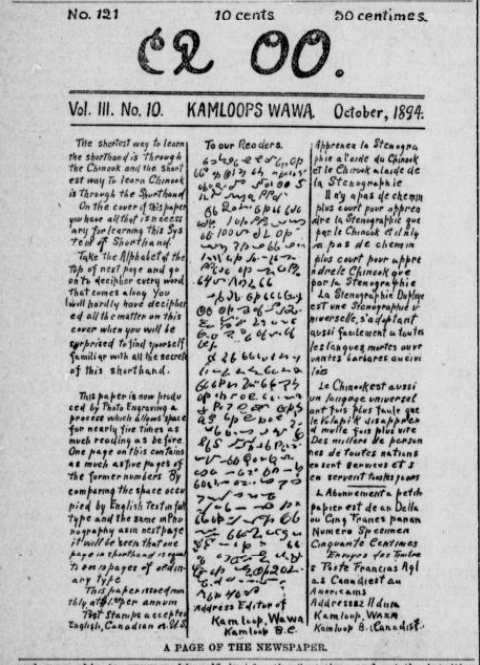
This was a well-illustrated article about the Chinook Jargon newspaper “Kamloops Wawa”.
I’ve tried to rearrange some lines that got printed out of sequence in the paper.
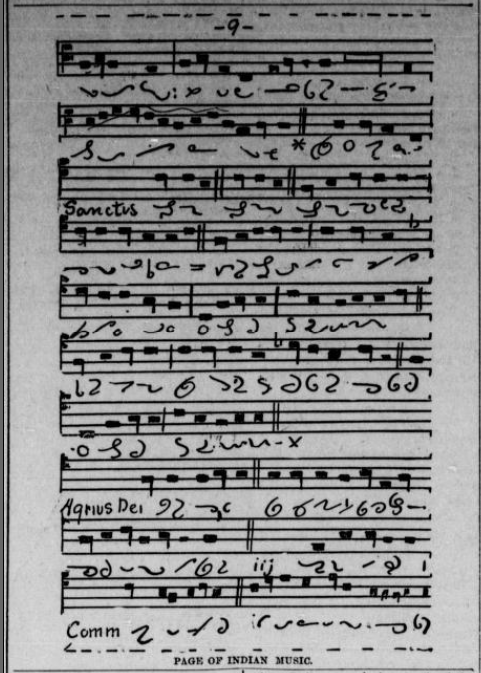
If you’d like a little brain exercise, try reading the images of Chinook Writing in this article. The newspaper’s artist wasn’t literate in that alphabet, so you may have some challenges ahead of you.
But this is a highly informative piece, much of it demonstrably repeating Father Le Jeune’s own words, and therefore his firsthand information.
TO CIVILIZE INDIANS.
QUEEREST NEWSPAPER ISSUED
IN AMERICA.Published in a System of Shorthand
in British Columbia by a Missionary
— Indians Readily Learn to Read the
Characters — Its Circulation.Work of a Priest.
One of the most wonderful achieve-
ments of any age is the Invention or
provision of some means or language
by which a com-
mon education, and
more especially the
teachings of Christ,
may be conveyed
to an Ignorant and
semi-heathen race.
Ever since the days
of early Scripture
missionaries have
been sent forth for
this purpose, and, strange as it may
seem, while we are dispatching miss-
ionarles to foreign, unenlightened
lands, foreign missionaries take up
their habitation among the Indians of
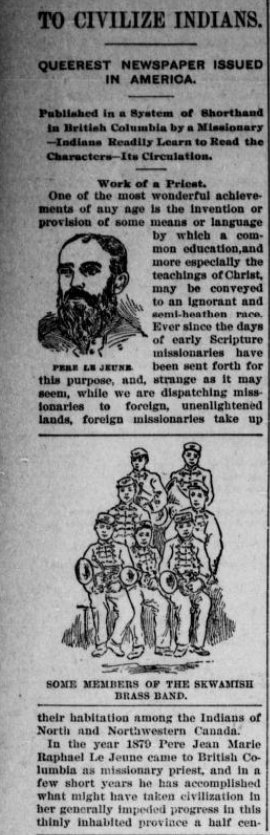
North and Northwestern Canada.In the year 1879 Pere Jean Marie
Raphael Le Jeune came to British Co-
lumbia as missionary priest, and in a
few short years he has accomplished
what might have taken civilization in
her generally impeded progress in this
thinly inhabited province a half cen-
tury to bring about the same effect.
Pere Le Jeune made his first acquaint-
ance with the Thompson Indians in
June, 1880, and has lived with them
ever since. A man gifted with a keen,
sparkling intellect, and reared with
refinement and education in Pleybert
Christ, Finistere, France, he takes up [end of sentence is missing]Pere Le Jeune at once began to study
the Chinook and Salishan languages,
and was able to express himself in
these tongues in a very short time. All
the elements of education he found
when he first came to this forlorn coun-
try was that a dozen or more Indians
knew a few prayers and the catechism
in the Thompson language. Beyond
this they were as ignorant as brutes.
Henceforth he took up his great phil-
anthropic work.
between Yale and Lytton, a distance
of fifty-two miles, trying to make ac-
quaintance with as many Indians as
would receive a white man into their
habitations. His struggles and efforts
were many, for’it is well known that
these Indians are both stubborn and
superstitious, and to this day there ex-
lats between the reds and the whites
that smouldering enmity which may
at any moment break out in treachery
and foul play. To reach thelr hearts
was to become one of them — learn thelr
languages and advance civilization
among them through the comprehen-
sion of their own tongue. This of course
required untiring patience and energy.
but Pere Le Jeune is at last rewarded
for his sacrifces, for now hundreds
of Indians look up to him as the means
of bringing into their narrow settle-
ments news of the great outside world.Since 1882 his mission has extended
to the Nicola Indians, who also speak
the Thompson language, and to the
Douglass Lake Indians, who are a
branch of the Okanagan family, where
he copied and revised most of the pray-
ers they have in use up to the present
day. Since June, 1891, he has had to
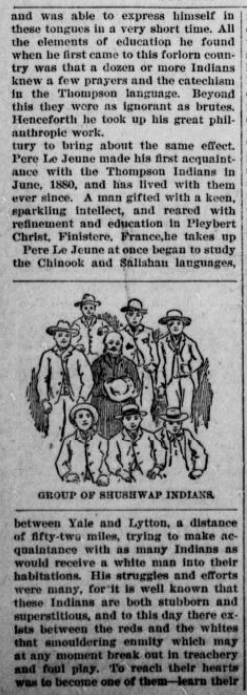
deal with the Shushwap tribe, and as
their language is simular to that used
by other Indlans, he very soon became
familiar with it. In 1892, the Fraser
Indlans and sea-coast Indians came un
der his notice. He tried several years
ago to teach the natives to read and
write in the English language, but
without avail. He soon found the race
very Impatient and impetuous, and it
was an utter Impossibility to teach
them to speak, read or write, or even
to write their own language in English
characters. Everything they did
learn, they were required to memorise
by repeating it over and over again,
and as soon as their instructor was out
of sight the Indians either neglected
their lessons altogether, or, in sheer in-
ability to learn forgot the first
rudiments taught them. As Pere Le
Jeune’s district was so extensive and
as he could only visit each tribe three
or four times a year, one can see how
difficult it was to impart any solid in-
struction. It took years after years to
make them understand a few instruc-
tions, only to be forgotten as soon as he
was gone.When every means had been ex-
hausted and the priest was discouraged
almost to complete dejection, a happy
thought struck him, and by that
thought hundreds of Indlans in Brit-
ish Columbia to-day have profited and
taken their first step toward education.Why not invent a system by which
the most simple mind might be taught
to read and write?When, in 1867 [this should say 1871], Pere Le Jeune was
a boy of 16, in France, he learned a
system of shorthand. This he now re-
sumed, and by simplifying it to meet
his own requirements, undertook to
teach It to the Indians. The first trial
was an instant success. This short-
hand is an easy phonetic writing, and
can be learned thoroughly in a few
weeks. Le Jeune himself was surprised
at the eagerness displayed by the na-
tives to learn it.Four years ago, a poor Indian crip-
ple named Charlie Alexis Mayoos, from
the Lower Nicola tribe, saw the writing
for the first time and got the intuition
of the system at first sight. He set to
work to decipher a few Indian prayers
and in less than two months had
learned the whole method thoroughly.
He soon began to help the priests by
communicating his learning to his
friends and relatives. From this time
on the Indians took up the system and
were anxious to learn on all sides
They nave now become aware of the
priceless benefits derived from an as-
siduous attendance to their school, and
are as eager to receive an education as
any white pupil. When once a few In-
dians know the system in one camp,
their ambition is to teach it to others
During the summer the progress is
slow, but when winter comes they
spend whole nights at it. One young
Indian, especially bright, took interest
In the writing as soon as he saw it. He
spent the whole night in repeating the
lesson over and over again with two or
three companions, and in two or three
days more completed his studies. In
less than a month he could read the
Indian language as well as the Chi-
nook, and soon was able to read and
write English in shorthand. Not only
do little children learn to read and
write readily, but even old people
study with success.The more advanced Indians under-
stand the value of the letters and the
spelling of the words, but the greatest
number begin by reading the words,
then the syllables by comparing the
words together, and at last come to
the letters. They learn by analysis
much quicker than by synthesis.After 600 or 800 Indians had learned
the system, It became necessary that
their interest should be kept up by
placing instructive matter before them.
As Pere Le Jeune was always on the
go, visiting each camp at intervals
only, it occurred to him to edit the
Kamloops Wawa, the strangest little
newspaper in America.The Wawa is really a full-fledged
newspaper, and it first saw the light
of day in the month of May, 1891.
“Wawa[“] is an Indian word meaning
“talk, speak or echo.” Hence the title
signifies “Kamloops Echoes.” “Kam-
loops,” the name of the town in which
It was inaugurated, is a Shushwap
word, meaning “the forking together
of rivers[“], in this instance the north and
south forks of the Thompson River.
The accompanying reproduction is the
fac-simile of the original paper, which
proves to be a curiosity in itself. It
contains four pages, and is about five
by seven Inches in size. At present
over 1,050 subscribers look forward to
their paper. The Kamloops Wawa is
issued weekly. At the start, when
funds were scarce, Pere Le Jeune
printed the news on any kind of paper
donated for the purpose, and some-
times the Indians received their news
on blue, red, yellow, and again on white
material.The printing of the paper is marvel-
ous. It is all done by hand, Pere Le
Jeune doing the work originally all
himself. At first the news was auto-
graphed, then duplicated on the mime-
ograph by the priest during the leisure
hours of his missionary labors. As the
subscriptions grew larger, a few In-
dian women were called in to help with
the printing, but this did not last
long, as the funds were still so low that
they had to be discharged, and the
work all fell back on the priest again.
The first volumes of this wonderful
little paper have been bound, copies
being sent to the Smithsonian Insti-
tution; also libraries in the East hold
copies as premiums. Some of the
original papers were lost or destroyed
by the Indians, but as many as could
be collected were bound. Many of the
pages of the little volume I have in
hand and from which the accompany-
ing cut is taken have been badly torn
and soiled by the Indians as they stud-
led its text. Pere Le Jeune informs
me he still has in his possession copies
of the original volumes for distribu-
tion. These in a few years, as well
as in the present, may be considered
valuable curiosities, for now the old
process mimeographing has been aban-
doned and electrotyping on a small
scale, by which three times as much
materlal appears weekly, has been sub-
stituted. The new Kamloops Wawa
contains sixteen pages. Its contents
consist chiefly of news from the sur-
rounding towns and wigwams, notices
of births, deaths, and marriages of the
Indians, with a new lesson or two of
the system, while a special feature is
made of the bible stories and religious
instruction. The white settlers in
Kamloops take little or no interest in
the paper, and the means with which
Pere Le Jeune carries on his noble work
are either donated or procured by sub-
scriptions to the little weekly. During
the winter Indians take infinite delight
in sending letters from camp to camp.Kamloops is situated on the north
and south branches of the Thompson
River, and the scenery around the
quiet little town makes it one of the
garden spots of the earth, especially
In the summer. In summer, the even-
Ing sunsets are gorgeous, and as far
as one can see down the broad, mir-
rored surface of the Thompson, noth-
ing meets the eye but the most mag-
nificent glorious scenes of nature’s
painting. In this little known region
which reaches far away to the lands
where perpetual night and everlasting
snow are common sights, there is a
touch of romance and mysticism
which cannot be described. The coun-
try is thinly settled yet, and many a
landmark remains which speaks with
thrilling vividness of an earlier race.
It Is a new occupation for them, who
till a few years ago did not know
what it was to read another man’s
“talk on paper,” and the idea is so
novel that they resort to many amus-
ing schemes in order to get correspond-
ents. Seventy-five to 100 natives sent
out letters to correspondents whom
they never saw or knew.Civilization, however, has made
rapid progress, and these North Am-
erican Indians are losing much of the
primitive savageness, and the early be-
liefs of idolatry and paganism are
giving way to the Christian religion.
Customs, manners, and even dress are
becoming modern, and in half a cent-
ury, or long before, every trace of ear-
lier barbarism will be swept away en-
tirely. Kamloops of to-day has some
2,000 inhabitants, and is the business
center of the surrounding country from
twenty-five to fifty miles distant. The
town was formerly a Hudson Bay fort
or trading post. It began to grow
after the construction of the Canadian
Pacific Railway. — Maibelle Justice, in
Chicago Herald.





— from the Crawford (MI) Avalanche of December 20, 1894, page 6, columns 1-4
Bonus fact:
If you click through to look at the original newspaper page, you may be amused by the graphics in the science article “Puss and the Scientists: Why Does a Cat Always Manage to Land on Its Feet?”
