“Newspaper salmon”, a PNW Indigenous English phrase (and a BC Chinook Jargon discovery)
A letter from a British Columbia Indigenous man in Chinook Jargon has puzzled me a bit:
Here’s the part of it that I’ve been musing on…
alta naika klatwa kopa mawntin
PRES 1sg to.go PREP mountain
‘Now I’m going to go to the woods.’naika tiki hant karabu pi karowan 9 pi pipa samin
1sg to.want to.hunt caribou CONJ ? nine CONJ paper salmon
‘I want to hunt caribou and (?”karowan”) and “paper” salmon.’
— 11 September 1894, Moose Dixon, Lake La Hache, BC
That pipa samin phrase is new to us. In the case of Northern Dialect Chinook Jargon, it appears to me that it’s a synonym for what we also know as “chum salmon“.
Do you know “chum salmon” is just an English-ization of CJ’s t’sə́m sámən (“marked salmon”)? And in the Northern Dialect, t’sə́m and pipa are synonyms meaning ‘written; marked’.
It just so happens that today’s blog post is inspired by my having come across a similar term, but in another kind of speech that comes from cultural contact — Indigenous people’s English in the Northwest: “newspaper salmon”.
I was looking at language materials at Eyak.org, when I opened their PDF of “Salmon Names“. There, I noticed the Eyak word GAsu’ ‘dry smoked salmon — old style “newspaper-fish” ‘. That sounds very much like a local expression, so I researched it some more.
It turns out that “newspaper fish” is a particular style of drying salmon, as a sort of sheet of delicious food. It’s in the illustration below.
And the only cultures I can find “newspaper fish” in are the dAXunhyuuga’ (Eyak) and their close neighbors, the Lingít (Tlingit), two ethnic groups in the northern part of southeast Alaska.
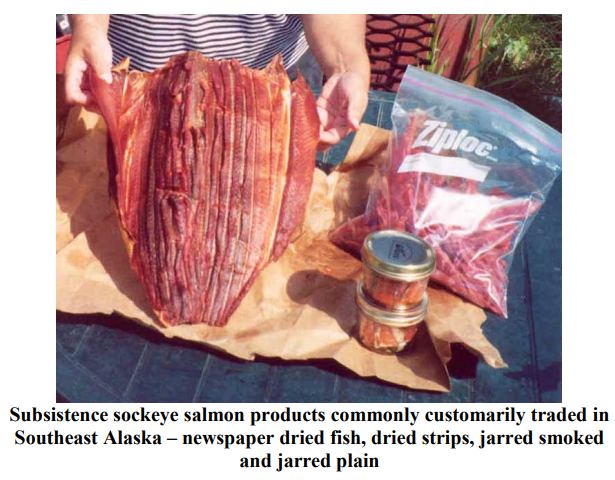
Image credit: this technical report by Steve Langdon
I find it interesting that the idea of “(news)paper salmon” was invented separately, twice, by Native groups separated by a few hundred miles and several decades, in two different languages!
