Lempfrit’s legendary, long-lost, linguistic legacy (Part 22)
The 22nd pair of pages (mis-numbered as “21” on the original page) from this precious document again brings us plenty of stuff worth knowing about Chinook Jargon.
(Here’s a link to the other posts in this mini-series.)
Where you see me underlining stuff here, it’s material that was added by the manuscript’s writer HT Lempfrit, from his good personal knowledge of the Jargon.
If you see the note “[SIC]”, it shows that someone mis-wrote a word. It wasn’t necessarily Lempfrit, since he was copying from someone else’s manuscript, Modeste Demers’ now-lost original to be exact.
So, where I’m showing differences between Lempfrit & somebody else, it’s Alphonse Pinart’s “Anonymous 1849” copy that I’ve been able to compare with.
Where you see [le]tters in square brackets, they’re not visible on the page copy that I’m working from, but we infer that they really are there!
By the way, the notation ___ means that the preceding entry is repeated in that position, along with some additional word(s).
See if you recognize words in these unusual spellings! I think we have a couple more small discoveries today, again showing the value of examining every Chinuk Wawa document — even those that appear to be straight copies of each other!
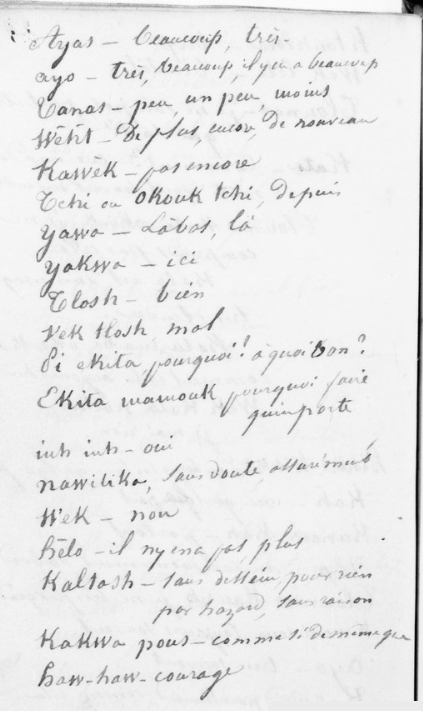
- ayas – beacoup, très – ‘a lot; very’
- ayo –très, beaucoup, il y en a beaucoup – ‘very; a lot; there’s a lot of…’
- tanas – peu, un peu, moins – ‘a little bit; a little; less‘
[The inclusion of a meaning ‘less’ is interesting in this Southern (earlyish) Dialect vocabulary, as it parallels the common Northern (later) Dialect treatment of lots of words as being scalar. That is, in this instance, tanas means not just ‘little’ but also ‘a little more’ or ‘a little less’.] - wêh̃t- de plus, encore, de nouveau – ‘moreover; again; once more’
- kawèk – pas encore – ‘not yet’
[Literally ka ‘still’ + wèk ‘not’.]
- tchi ou okouk tchi – depuis – ‘since’
[Okouk tchi has a distinctly early-Chinook-Jargon sound to it; it’s literally ‘this just now’.] - yawa – là bas, là ‘over there; there’
- yakwa – ici – ‘here’
- tlosh – bien – ‘well’
- wek tlosh – mal – ‘bad(ly)’
[Literally ‘not good’. The normal expression for ‘bad’.] - pi ekita – pourquoi? à quoi bon? – ‘why?; what’s the point?’
[Literally ‘and what?’ Ekita was commonly used for ‘why’ in early Jargon.] - ekita mamouk – pourquoi faire; qu’importe – ‘why do it?; why does it matter?’
[Literally ‘what makes (it)’.] - iuh iuh* [Rena V. Grant’s 1946 transcription of Alphonse Pinart’s 1849 copy of the same document gives inh-inh] – oui – ‘yes’
[Is this a variant spelling of aha?] - nawitika – sans doute, assurément – ‘without a doubt; certainly’
- wek – non – ‘no’
- hēlo – il n’y en a pas, ____ plus – ‘there isn’t any; there’s no longer any more’
- kaltash – sans dessein, pour rien, par hazard, sans raison – ‘without a plan; for nothing; by chance; without reason’
- kakwa pous – comme si, de même que – ‘as if; just as’
[Literally ‘as if’.] - haw-haw – courage – ‘courage’
[This looks like a good match for George Gibbs’s howh ‘turn to; hurry’, but the reduplication is novel.]
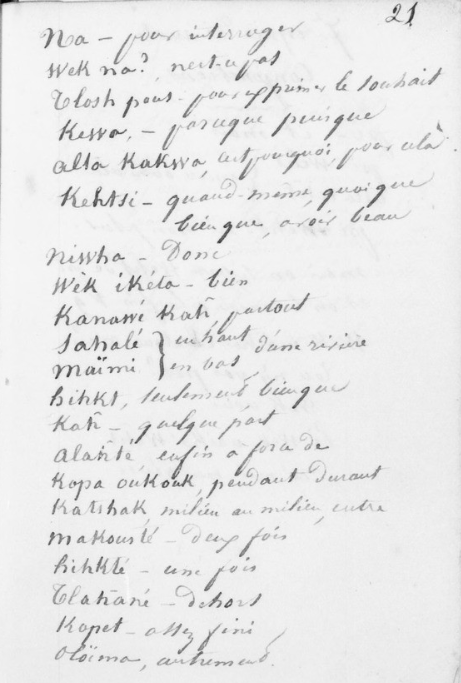
- na – pour interroger – ‘to ask a question’
- wek na? – n’est-ce pas – ‘isn’t it so?’
[Literally ‘is it not?’]- tlosh pous – pour exprimer le souhait – ‘to express the wish’
[Literally ‘good if’.]- kewa – parceque, puisque – ‘because; since’
- alta kakwa – c’est pourquoi, pour celà – ‘it’s because; for that reason’
[Literally ‘now being like that’.]- kehtsi – quand-même, quoique, bien que, avoir* beau – ‘nevertheless, although, although, ???’
[Rena V Grant also has this “avoir beau”, which I don’t understand. Do my readers have ideas?]- niwha – donc – ‘so’
- wèk ikéta – bien – ‘all right’
[Literally ‘no thing’.]- kanawé kah̃ – partout – ‘everywhere’
[Literally ‘all-where’.]- sahalé – en haut d’une rivière – ‘up a river’
- maïmi – en bas d’une rivière – ‘down a river’
- hihkt – seulement, bien que – ‘only; although’
- kah̃ – quelque part – ‘somewhere’
- alah̃té – enfin, à force de – ‘finally; by dint of’
- kopa oukouk – pendant, durant – ‘while; during’
[Literally ‘in that/in this’.]- katshak – milieu, au milieu, entre – ‘middle; in the middle; between’
- makousté – deux fois – ‘twice’
- hihkté – une fois – ‘once’
- tlah̃ané – dehors – ‘outside’
- kopet – assez(,) fini – ‘enough; finished’
- oloïma – autrement – ‘otherwise’

avoir beau + verb <=> to strive in vain to + verb
j’ai beau vous parler, vous ne comprenez rien
even if I try to talk to you, you don’t understand anything
LikeLiked by 1 person