1922: John W. Pettigrew doggerel
John W. Pettigrew sent his local Oregon newspaper “a specimen verse of genuine handmade Oregon poetry”, asking for people’s evaluations of it.
(Here’s a link for lots more Chinook-related doggerel.)
Pettigrew jokingly said his poetry wasn’t first-class “like…Woodyard Kipling”, but he asked for a fair chance, in the paper’s “Listening Post” column.
About some of the Jargon words in his composition, Pettigrew commented, “I am not very familiar with the Indian names of some of the animals and may make mistakes. However, most folks won’t know the difference.” (Probably true, so long into the post-frontier era.)
So let’s share his Chinook Jargon-related doggerel verse here:
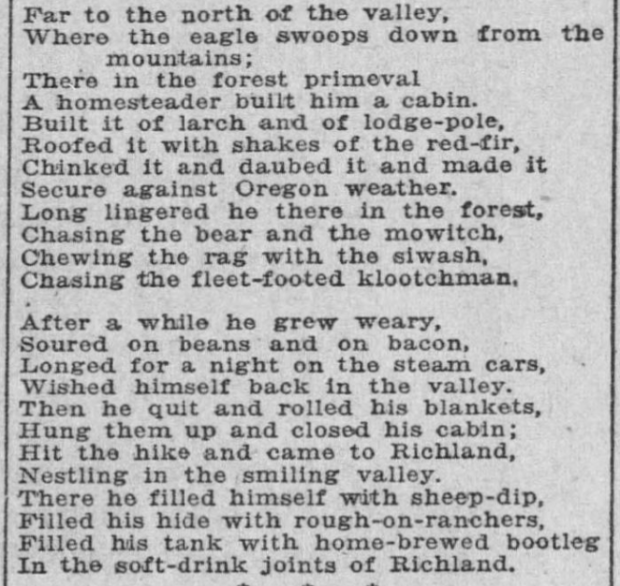
Far to the north of the valley,
Where the eagle swoops down from the
mountains;
There in the forest primeval
A homesteader built him a cabin.
Built it of larch and of lodge-pole,
Roofed it with shakes of the red-fir,
Chinked it and daubed it and made it
Secure against Oregon weather.
Long lingered he there in the forest,
Chasing the bear and the mowitch,
Chewing the rag with the siwash,
Chasing the fleet-footed klootchman.After a while he grew weary,
Soured on beans and on bacon,
Longed for a night on the steam cars,
Wished himself back in the valley.
Then he quit and rolled his blankets,
Hung them up and closed his cabin;
Hit the hike and came to Richland,
Nestling in the smiling valley.
There he filled himself with sheep-dip,
Filled his hide with rough-on-ranchers,
Filled his tank with home-brewed bootleg
In the soft-drink joints of Richland.
— from “The Listening Post” by De Witt Harry, in the Portland (OR) Morning Oregonian of March 15, 1922, page 10, column 5
One of Pettigrew’s wry comments is that a college-educated neighbor (a rarity in those days), upon reading this sample, called him a plagiarist. The joke there is that this folk-verse is more or less in trochaic tetrameter, the most famous example of which, in the USA, was the popular “Song of Hiawatha“.
Bonus fact:
This poem gives us some verification that “steam cars” was indeed a phrase in Pacific Northwest English. I first learned it from, guess what, Northern Dialect Chinook Jargon, where it’s the most commonly found word for ‘a train’!
