1885: Warm Spring(s) Agency, Oregon — they all speak the Chinook
They all talk Jargon!
Here are some of them…
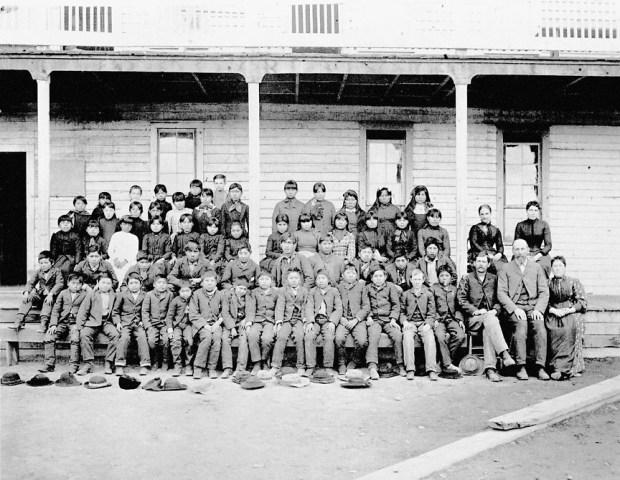
Here’s the Warm Springs Agency Boarding School in 1890 (image credit: Oregon History Project)
I’m reprinting this entire letter to the editor, because it gives a good deal of contextual information that helps us understand why the Jargon was in such heavy use at Warm Springs Reservation in northwestern Oregon.
And this is pretty late in the frontier era, even.



WARM SPRING AGENCY.
October 20th, 1885.
Thinking a few lines from this place
might be of interest to your readers, I
will endeavor to give you a brief de-
scription of the Agency and the business
connected with the same.There are about nine hundred Indians
on the Reservation, which was shown
by the census of last year. They are
of five different tribes, namely, the Warm
Springs, Wascoes, Piutes,Teninoes and
John Days. The Warm Springs are
the Indians with whom the treaty was
made. They number about 250. The
Wascoes who were next to be placed
on the Agency number about 400. The
other tribes are stragglers that came
here of their own accord. Three lan-
guages are spoken on the Reservation,
the Wascoes, Teninoes and John Days
speaking the same [Chinookan] language. The Warm
Springs [Sahaptians] and Piutes each have a lan-
guage of their own, although some of
the Wascoes speak the Warm Spring
language.In regard to the schools, there are
two, one at the Agency, and one twenty
miles distant, which is principally for
the Warm Springs, as they do not like
to mix and mingle with the other tribes.
There are 216 children between the ages
of 6 and 16. The schools are boarding
schools. The employe[e]s of each school
are, teacher, salary, $800, industrial
teacher, $800, matron, $480, seamstress.
$480, cook, $320. W. H. Brunk,
formally of Albany, is teacher at the
school twenty miles away. The em-
ployes for the Agency are clerk, salary,
$800, physician, $800, carpenter, $720,
farmer, $600. That is all the employes
that are allowed on the Agency, except
the police, which are Indians, also in-
terpreter,$300.In regard to civilization, there is
about one out of every twenty that
speaks a little English. They all speak
the Chinook. There are a few who
have attended the Forest Grove school,
and have learned to read and write.
A few young ladies play the piano and
sing nicely, but they are exceptions. The
children who attend the Agency school
are small, but as soon as they learn our
language, they are sent to the Salem
Training school. The scholars were
sent from here last week. Thry num-
bered nineteen, which is the most that
ever went from this Agency. There
remains in the two schools about seventy
children. It is a very difficult matter
to get the Indians to send their children
to school. The way the schools are
kept up, if the Agent knows of a child
that ought to be at school he sends a
policeman after it.The goods received from the Depart-
ment for this year are arriving now.
They consist of about twenty-five four
horse loads from The Dalles. The
goods are issued to the Indians, with
the exception of wagons, harness and
plows, which are sold to the Indians at
cost prices, and paid for in work, such
as freighting, etc.The authority which governs the In-
dians consists of eleven police, three of
whom act as Judges. They try all
causes of misdemeanor, and say what
the fine shall be. The Agent has the
right to take exceptions to any of their
ruling. The salary of the police is $12
per month for the three Judges, and $8
for the privates. They have the same
right to make an arrest that a Consta-
ble does, and any one resisting an officer
is punished. They wear uniforms and
badges.In regard to farming, Indians farm
on a small scale, some not farming more
than one or two acres. Of course there
are a few exceptions. Some few may
have as much as ten acres. The soil
is very productive. In small tracts
along the creeks the Indians raise nice
gardens with little work. They seem
to like stock raising better than any
other industry, as there is little labor
attached to it, but the snow of last
winter killed a large number of their
horses. It is estimated about 3000
head died from starvation.The Indians are making more prep-
aration for winter this fall than ever
before, Some have small stacks of
straw and hay for winter. The govern-
ment furnishes tools for them to work
with, and all the work about the Agen-
cy that they can do, they are given the
preference. There is considerable more
work around an Agency than one would
suppose. The mail is received here
three times a week. It is from Hay
Creek, on the Prinesville and The
Dalles road. There is talk of a line of
stages being established between Prines-
ville and The Dalles by way of the
Agency, as it is a nearer route.X.
— from “Correspondence”, in the Albany (OR) State Rights Democrat of October 30, 1885, page 2, column 2
