Myron Eells’s hymn book (Part 8: Heaven)
Song #8 from Myron Eells’s little book, “Hymns in the Chinook Jargon Language“, 2nd (expanded!) edition (Portland, OR: David Steel, 1889):
(Here’s a link to all installments in this mini-series.)

The Hot Tamale Heaven truck in Greenville, Mississippi (image credit: Flickr)
It’s “Heaven”. Like most of Reverend Myron Eells’s Chinuk Wawa religious songs, this isn’t necessarily a translation from any English-language original.
Also standard for his strategy, it’s to the tune of an existing well-known song among Settlers, in this case “Greenville“.
The lyrics here, as usual for Eells, are tailored for his audience, making use of such non-biblical themes as drunkenness and Indigenous people.
The grammar here is interesting. For instance, Eells negates clauses (sentences) variously with wik and hilu. This is a different situation from the Southern Dialect, where we tend to find folks using only wik, and the (later) Northern Dialect, where they tend to use only hilu. In terms of both geography and time, Eells’s Puget Sound usage is in between those two extremes.
His lyrics here are more Settler English-influenced than is typical for Eells.
- For example, he uses the animate pronoun yaka in reference to ‘the streets’, instead of the more technically correct “silent IT” (Ø).
- And he uses the English noun plural -s on houses and tillikums. I also notice he uses klahowya without its original final m, in line with Settler habits.
- To my mind a sign of literate English influence is the complex interpolation in ‘Jesus gives to the Natives, if you folks are very good, everything you want’. Good speakers of Jargon do interrupt the flow of speech to add a pronoun (here potentially “to you folks“), but it’s not normal to find an inflected verb phrase used like this “if you folks are very good“.
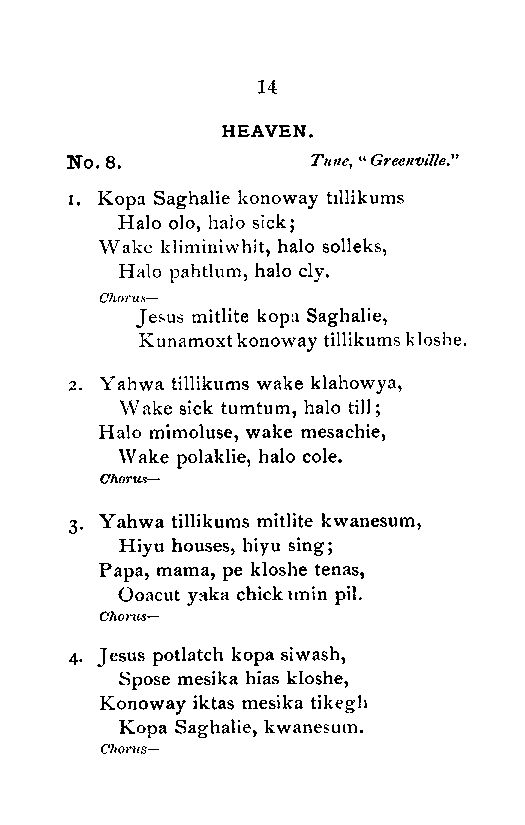
I. Kopa Saghalie konoway tıllikums
kʰupa sáx̣ali kʰánawi tílixam-s
‘In heaven everybody’
Halo olo, halo sick;
hílu úlu, hílu sík;
‘is not hungry, not sick;’
Wake kliminiwhit, halo solleks,
wík t’łəmínxwət, hílu sáliks,
‘doesn’t tell lies, isn’t angry,’
Halo pahtlum, halo cly.
hílu pʰáłlam, hílu kʰláy.
‘isn’t drunk, isn’t crying.’Chorus-
Jesus mitlite kopa Saghalie,
djísəs* míłayt kʰupa sáx̣ali,
‘Jesus is in heaven,’
Kunamoxt konoway tillikums kloshe.
kʰanumákwst kʰánawi tílixam-s łúsh.
‘with all the people who* are* good.’2. Yahwa tillikums wake klahowya,
yawá tílixam-s wík łax̣áwya(m),
‘There the people aren’s suffering,’
Wake sick tumtum, halo till;
wík sík-tə́mtəm, hílu tʰíl;
‘not upset, not tired out;’
Halo mimoluse, wake mesachie,
hílu míməlus, wík masáchi,
‘not dying, not evil,’
Wake polaklie, halo cole.
wík púlakʰli, hílu kʰúl.
‘no darkness, no cold.’
Chorus-3. Yahwa tillikums mitlite kwanesum,
yawá tílixam-s míłayt kwánəsəm,
‘There the people stay forever,’
Hiyu houses, hiyu sing;
háyú háws-əs, háyú síng;
‘lots of houses, lots of singing;’
Papa, mama, pe kloshe tenas,
pápa, máma, pi łúsh tənás,
‘fathers, mothers, and good children,’
Ooacut yaka chick umin pil.
úyx̣ət yaka chíkʰəmin-pʰíl.
‘the paths are gold.’
Chorus-4. Jesus potlatch kopa siwash,
djísəs* pátłach kʰupa sáwásh,
‘Jesus gives to the Natives,’
Spose mesika hias kloshe,
spus msayka hayas-łúsh,
‘if you folks are very good,’
Konoway iktas mesika tikegh
kʰánawi-íkta-s msayka tíki
‘everything you want’
Kopa Saghalie, kwanesum.
kʰupa sáx̣ali, kwánəsəm.
‘in heaven, always.’
Chorus-
Now Eells’s own suggested translation into English —
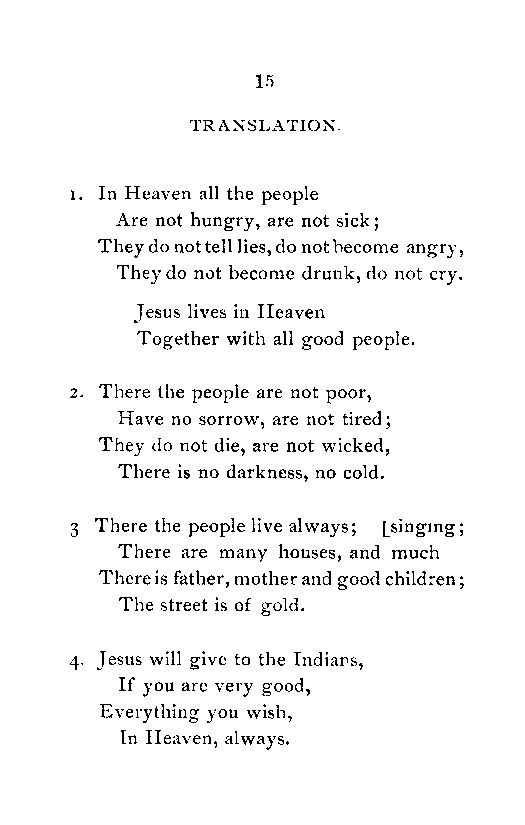
TRANSLATION.
I. In Heaven all the people
Are not hungry, are not sick;
They do not tell lies, do not become angry,
They do not become drunk, do not cry.
Jesus lives in Heaven
Together with all good people.2. There the people are not poor,
Have no sorrow, are not tired;
They do not die, are not wicked,
There is no darkness, no cold.3 There the people live always; [singing;
There are many houses, and much
There is father, mother and good children;
The street is of gold.4. Jesus will give to the Indiars,
If you are very good,
Everything you wish,
In Heaven, always.
