1866, Olympia, WA: “Nocturnal Scenes” doggerel — or documentary?
I won’t be surprised if we learn that the following poem is an accusation of a real murder!
It qualifies for our file of Pacific Northwest doggerel poetry because it uses the word klooch.

The great god Pan on a couch, alone, at my college (image credit: Wikipedia)
That’s a borrowing from Chinuk Wawa’s łúchmən ‘woman’ into regional English, to become a synonym for the “S-word”.
I might take the character “Pan” to represent a Native man, or else a Settler-colonizer who took an Indigenous wife.
Either such marriage might actually trigger the murderous, racist rage of a Settler neighbor such as “Ben”.




Poetry.
[For the Pacific Tribune.]
NOCTURNAL SCENES.“I dreamt a dream which was not all a dream.”
‘Twas lovely night when Luna bright
Shed forth her softest, silv’ry ray.
And while I glanc’d its sheen enchanc’d
O’er Port Discov’rys’ placid bay ;
A night as Fancy’s muse could tell.
‘Mid its calm scenes I fain would dwell.By a brooks’ [sic] mouth at th’ extreme South,
Methought two lowly hovels stood,
That one was Ben’s, the other Pan’s
Just by the margin of a wood;
And that these two could ne’er agree,
For Mam[m]on sway’d their destiny.But what’s astir by yonder fir.
Can it be its shadow moves?
Perchance some sprite of gentle night
Arose to view the scene she loves ;
Yet ah, ’tis mortal Ben invades
Why lurk he lone in midnight shade.Lo, look he glides with noiseless strides,
And now is in his neighbor’s home.
A fitful glare is flick’ring there
From dying embers worse than gloom ;
Upon his visage in that glare
By conscience carv’d foul fiend read there.On an humble couch were Pan and klooch,
By Morpheu[s]’s arms unconcious lain,
To Pan entranced the fiend advanc’d,
An axe be buried in his brain ;
The door was closed, — the murd’rer gone,
And still my vision follow’d on.At his house nigh, I ask’d him “why
Those finger blood prints on thy door,
Why not repose, why washed thy clothes,
Why newly cleaned thy filt[h]y floor ;
In short who made that mangled corse,”
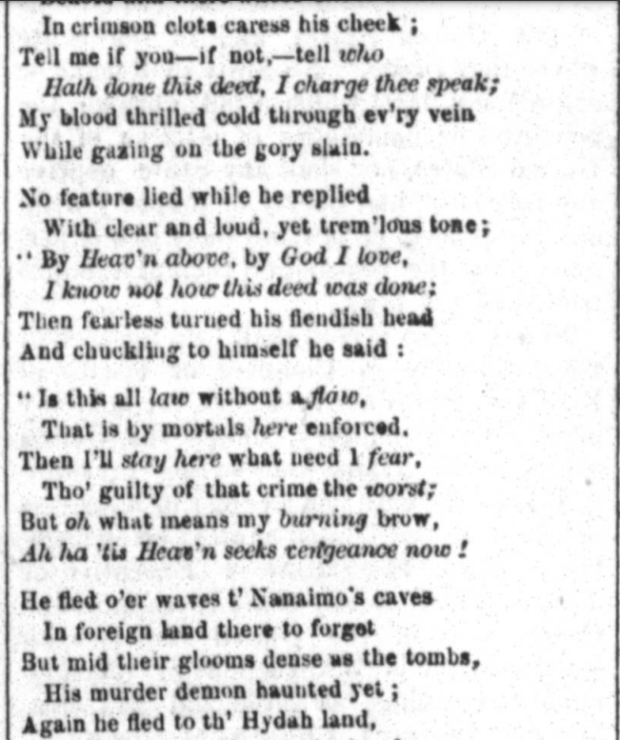
(I brought him to’t methought per force.)“Behold him there whose silver hair
In crimson clots caress his cheek ;
Tell me if you — if not, — tell who
Hath done this deed, I charge thee speak;
My blood thrilled cold through ev’ry vein
While gazing on the gory slain.No feature lied while he replied
With clear and loud, yet trem’lous tone;
“By Heav’n above, by God I love,
I know not how this deed was done;
Then fearless turned his fiendish head
And chuckling to himself he said:“Is this all law without a flaw,
That is by mortals here enforced.
Then I’ll stay here what need I fear,
Tho’ guilty of that crime the worst;
But oh what means my burning brow,
Ah ha ’tis Heav’n seeks vengeance now!He fled o’er waves t’ Nanaimo’s caves
In foreign land there to forget
But mid their glooms dense as the tombs,
His murder demon haunted yet ;
Again he fled to th’ Hydah land,
For refuge ‘mong its swarthy band.But fate severe that even here,
Should dwell his victim’s native spouse,
Who told the tale with wo[e]ful wail,
Intent their savage wrath to rouse ;
They rose for vengeance and its spoil
And hewed him from his “mortal coil.”The body dead his spirit sped,
For mercy to a world on high,
This view tho’ brief I had as lief
Die twenty deaths ere wink an eye ;
Mortals may seek one earthly bliss
But naught sublunar likens this.There living light extends the sight
Thro’ regions limitless of Heav’n;
Where angel throngs sing dulcet songs
In gratitude for sins forgiv’n ;
While joyful laughing legions come
There welcom’d to eternal home.The fiend alone from Heav’n was thrown,
Adown his shrieking soul was hurl’d,
He ‘mong the stars pass’d gory Mars,
But e’en that God’s proud lip was curl’d ;
Adown thro’ darkning [sic] vaults of night,
My vision follow’d in the flight.The heav’ns afar not e’en a star
Illumed the murky realms of space,
Soon Limbus clouds Hell’s dreadful shrouds
Loom’d up before us face to face ;
Fiercely the fiend impatient spoke
His accents like the thunder broke.“Avaunt vain man, ’twas I slew Pan.
What stay thou still to further know,
Then tell earth’s lords that crime affords,
Eternal heritage to woe;
Terror’s tears cours’d his tawny face
While haggard horror stalked the place.Fierce thunders rent Hell’s firmament
While forky lightning’s forced him in,
With firey fangs to hell’s dread pangs,
The foremost ‘mid the awful din ;
Where murder’s minions moanful come
Eternal Pandemonium.My spell-bond broke — Boreas spoke,
I know his voice made Neptune roar ;
For tide-drifts dash’d, huge surges splash’d
Along the dismal dreary shore ;
A night as Fancy’s muse could say
‘Mid its wild scenes I would not stay.DREAM in thy mystic words of woe and shame
I’ve told a tale, to which my heart replies
With voiceless throbbing and devoted sighs :
Death’s darkest agony and mercy’s claim.— Port Discovery, W.T. May 22d, ’66
— from the Olympia (WA) Pacific Tribune of June 16, 1866, page 1, columns 2-3
