The long-running rumor about innocently cussin’ Indians
In a previous post here, I showed a 1915 memoir that claimed to document how cussin’ ‘n’ Chinookin’ went together in frontier-era Idaho…
But now it seems we have to call that a mistake (even if the other Jargon quoted there may be real), while finding other, slightly stronger evidence that “god dam” was indeed used in the Jargon.
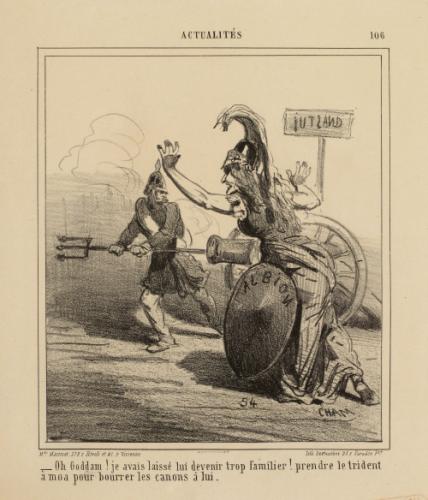
“Oh Goddam! je avais laissé lui devenir trop familier ! prendre le trident / à moa pour bourrer les canons à lui.” (Image credit: Paris Musees)
Stronger evidence, from a linguist’s point of view, because I’m finding god damn, in various spellings, being used in a shifted syntactic category, from the original English interjection to a possibly Chinuk Wawa noun.
The New York Sun of July 16, 1894, mentions Native people calling (some) Whites “woh-hars” and “god-dams”.
I’ve also found a German version (including comments on Chinook Jargon), from which I’ll show a crudely snipped quotation, because I know I have German-reading readers:
77 höchstens drei Monaten aneignet Bücher und Zeitungen werden in ihm gedruckt Im Jahre 1840 stellte der unter den Cree Indianern als Missionar wirkende Rev James Evans ein verbessertes phonetisches System her dessen Zeichen aus Kreisen Quadraten und Teilen von ihnen bestehen Mit vieler Mühe schnitzte Bev Evans die Zeichen aus Holz und gofs sie dann aus dem Blei von Theekisten das ihm die Beamten der Hudson Bay Company geschickt hatten Mit einigen Änderungen ist dieses System heute nicht nur bei den Crees sondern bei zahl reichen anderen Stämmen des Nordwestens im Gebrauche Chinook ist wohl der merkwürdigste Jargon der in dem dünn besiedelten Nordwesten bis Alaska als allgemeine Verkehrssprache dient ein halbes Dutzend verschiedener Indianer sprachen und Fragmente von Englisch Französisch sowie Deutsch haben die Elemente für dieses Kauderwelsch geliefert Ein französischer Priester im Kam loops British Kolumbien der als Missionar in einem Territorium von mehr als 500 Quadratmeilen Gröfse wirkt veröffentlicht ein Drittel seiner Zeitung Waswa Schrift in diesem Jargon für die beiden anderen Drittel benutzt er steno graphische Zeichen und Englisch Die Zeitung die auf blauem weifsem gelbem grünem usw Papier gedruckt wird enthält Neuigkeiten aus den Missionen und Ansiedelungen Predigten Gebete usw und wird von dem Priester unentgeltlich verteilt Die ersten Anfänge des Chinook werden auf die Abenteurer Lewis und Clark zurückgeführt die die ersten Weifsen waren die die Pacificküste be suchten und denen später die Männer von Jacob Astors Pelzkompagnie folgten An zwanzig Indianerstämme deren Sprachen von einander grundverschieden sind und alle Händler bedienen sich dieses Jargons Die Weifsen werden darin in Wo hars und Goddams geteilt und zwar bezeichnet das erste Wort Fuhr leute und das letzte Gentlemen eine allgemeine Bezeichnung für einen Weissen ist Boston Der Ethnologe Piliing der bereits eine Anzahl von Werken über Indianersprachen in den Vereinigten Staaten und Canada veröffentlicht hat arbeitet zur Zeit an einem Buche über die Navatksprache Westl Post
77 books and newspapers are printed in it for a maximum of three months. In 1840, the Rev James Evans, who worked as a missionary among the Cree Indians, created an improved phonetic system whose characters consist of circles, squares and parts of them. With much effort, Rev Evans carved the characters made of wood and then made them out of the lead from tea boxes that the officials of the Hudson Bay Company had sent him. With some modifications, this system is now in use not only by the Crees but by numerous other tribes of the northwest. Chinook is probably the strangest jargon of all A half-dozen different Indian languages and fragments of English, French and German serve as the common lingua franca in the sparsely populated northwest to Alaska. A French priest in Cam loops British Columbia who served as a missionary in a territory of more than 500 square miles Gröfse publishes a third of his newspaper Waswa script in this jargon for the other two thirds he uses stenographic characters and English. The newspaper which is printed on blue white yellow green etc paper contains news from the missions and settlements sermons prayers etc and is published by the Priests distributed free of charge The first beginnings of the Chinook are traced back to the adventurers Lewis and Clark who were the first white men to visit the Pacific coast and who were later followed by the men of Jacob Astor’s fur company. To twenty Indian tribes whose languages are completely different from one another and all traders use each other This jargon The Whites are divided into Wo hars and Goddams and the first word refers to carters and the last gentlemen is a general term for a white person. Boston The ethnologist Piliing who has already published a number of works on Indian languages in the United States and Canada is currently working on a book about the Navatk language Westl Post
I’m perceiving that there was, separate from anyone’s awareness of Chinook Jargon, an existing stereotype that Native people had picked up very little of English beyond some cuss words. Here’s a history of the Oregon Trail that uses this pervasive folk idea about the corrupting influence of Whites:
An emigrant wrote
that the only English words some tribes knew were “Whoa,” “Gee,”
and “God damn,” which they used as polite greetings; he added that
one company that asked Indians where there was good camping ground
was told that there was plenty of grass nearby for the “Whoa-haws”
but no water for the “God-damns.”
The stunning thing is that the earliest connection I’m finding between “god damn” and Indigenous people’s speech is…in a classic publication that we happen to know well in Chinook Jargon world! Granville Stuart’s excellent “Montana As It Is“, published in 1865, has this, but the twist is that even though it’s connected with a place in Idaho, it’s referring to Sioux (Lakhota, Dakota, etc.) people much farther east:
Note 7, page 23: “Wock’-way” — means “The Cedar
Butte.” It stands isolated in the plain of Snake river valley,
not far from the mouth of Lewis fork, about twelve or fifteen
miles above where the road from G[reat]. S[alt]. L[ake]. City to Virginia City
leaves Snake river. It is thinly covered with scrubby cedars,
and served the Indians for a landmark in their peregrinations
in this vast valley, before the days of roads and wagons, and
“Wo-Haws” and “God-Damns,” as the Sioux call cattle
and their drivers. [page 51]
Bonus fact:
It’s a mere coincidence, but goddam + Chinook are found close together (albeit unrelated) several years before the publication of the newspaper article that inspired today’s post; this is in an article in Science.
And the Yakama guide Sluiskin, speaking Jargon in an 1876 article, calls a White guy “hiyu goddam“.
And this stereotype surely traces even farther into the past, with English-speakers by 1808 claiming that the French called them les god-damns.
