Klootchy Creek, Oregon’s Métis history
Thanks to Abby Mortimer in the Facebook CJ group!
Abby mentioned, in response to my recent article “1889: TALES OF OKANOGAN SMITH AND HIS “KLOOCH”“, a body of water she’s acquainted with:
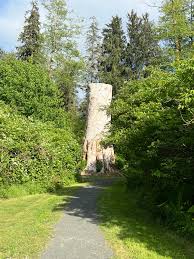
The Klootchy Creek spruce (image credit: Wikipedia)
Klootchy Creek, in Clatsop CountyOregon, formerly home to the largest tree in that state. (It’s also spelled Klootchie Creek.)
The name of that stream seems to have gotten connected with the Chinuk Wawa-into-English loanword klootch. That’s a regional word for Native women, from CW łúchmən ‘woman’.
But we haven’t seen a seemingly diminutivized / nickname-ish klootchy before.
Some resourceful digging by CJ group member Luke Etxeberria revealed that the creek is thought to have been named for Antoine Cloutrie.
What’s clear is that the “official” spelling of that Settler’s name is Cloutier.
(That’s literally ‘maker of nails’, and related to Chinuk Wawa lekʰlu ‘a nail’. It’s a reasonably common name.)
And he was a French Prairie (Grand Ronde Reservation area) Métis, born in ?1836, son of (?Antoine) Cloutier and Catherine Walla Walla. So he was almost certainly a speaker of early-creolized Chinuk Wawa.
The predictable Canadian/Métis pronunciation of his “proper” last name would be, in Grand Ronde-style spelling, kluchiyi ~ kluchi!
That is, “Klootchy”. Thus he was surely known to his neighbors.
And that name naturally got spelled that way on maps, in the best quasi-phonetics that my dear old mother tongue of English can manage.
Those spelling limitations, we speculate, would’ve naturally called to mind the local word klootch.
And Antoine Cloutier may have already been associated in folks’ minds with klootch, due to his mother’s Indigenous ethnicity. It could as well have had to do with his Chinookan-Canadian Métis wife, née Helen Lattie, born at Fort Vancouver in 1836.
My usual authority for Oregon geographical names, McArthur & McArthur’s fine book, has nothing about this creek, which is why we’ve had to do all of this research on our own.
All told, this is an interesting little story of northwest Oregon Métis people and of Chinook Jargon!
