Father J-M Le Jacq’s northern Chinuk Wawa came from the south
Something I’ve claimed for years becomes very apparent as you read through “Kamloops Wawa” #86 (July 9, 1893) … also #91, #92, and many more issues of the old Chinook Jargon newspaper.
The Northern Dialect Chinook Jargon written (and thus spoken) by the mainly Belgian and French priests who staffed the Catholic missions in British Columbia can be definitely traced to the Southern Dialect of Chinook Jargon.
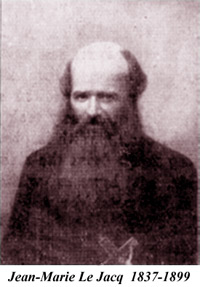
Image credit: OMI World
These European priests clearly were taught the older, Southern Dialect on their way out here to the Pacific Northwest.
They weren’t taught the Northern Dialect, which they had to pick up after they got here.
As a consequence, they wound up speaking in some ways like outsiders.
An example is Father Jean-Marie Le Jacq (1837-1899) from Roscoff, diocese of Quimper in Brittany, northwestern France, who
set out for British Col[u]mbia where he worked, first of all, in Victoria (1862-1863). There he ministered to the Irish population and visited the Indians of Esquimalt. He then went to Fort Rupert on Victoria [actually Vancouver] Island (1863-1866) and from there he visited the Queen Charlotte Islands [Haida Gwaii] (1864), then Mission City (1867-1868) and Williams Lake (1868-1873). He founded the mission of Fort Saint James, at Stuart Lake (1873-1880). He was then entrusted with the mission of Kamloops (1880-1891) and from there he returned to Williams Lake (1891-1898). Therefore he ministered throughout the district of Kamloops.
This career sketch has Le Jacq working entirely within the range of the Northern Dialect, at a time when it had already taken shape as far as we’re aware.
Therefore, it’s notable how very Southern-Dialect a number of recurring features are in Le Jacq’s use of Chinuk Wawa.
Here’s a small sample of Le Jacq’s ample written legacy in CW, to show you what I’m talking about. It’s from Kamloops Wawa issue #86, 09 July 1893…
Page [109]:
…iaka skukum wawa: “Piltin tanas man”…
‘…he shouted, “Crazy boy…” ‘
[In the Northern Dialect, piltin has changed to a meaning ‘sinful’.]…
wik masashi ukuk
‘that’s not evil’
[In the Northern Dialect, wik has been replaced by (h)ilo to negate a sentence.]…
= Klityus wawa: “Kaltash kanawi maika wawa: Wik kakwa…”
‘Cletus said, “Everything you say is garbage; it’s not so…” ’
[See previous comment.]
…Wik naika kwash: Kopit ST naika kwash
‘I’m not afraid; it’s only God that I fear’
[See previous comment.]
…Pages 109-110
Msaika mamuk kanawi kata klahawiam Katolik tilikom pi klaska mimlus
‘You folks treat Catholic people every which way until they die.’
[Mamuk-kata and its derivative mamuk-kanawi-kata are distinctly Southern Dialect.]…
= Pi kopa ipsut iaka wawa kopa klaska: “Kaltash msaika mamuk kwash iaka.”
‘But in secret he told them, “Just scare him.” ‘
[Kaltash means ‘only’ in the Southern Dialect; it never means that in the Northern Dialect, where it serves to express ‘uselessly; to no avail’.]…
Page 111
Alki naika styuil pus msaika
‘I’m going to pray for you.’
[It’s only in the Southern Dialect that pus means ‘for’ a noun or pronoun; in the North, kopa is used for that sense.]
Me being the guy who tries to teach you about my idea of “linguistic archaeology“, I find these examples very useful for showing how Chinuk Wawa — like every other language — preserves chronological layers of history in itself.
Father Le Jacq, who presumably never once set foot in Southern Dialect territory, nonetheless kept alive numerous Southern usages that had been taught to him by generations of priests who served prior to the (1855+) existence of the Northern Dialect.
