1881, WA/NYC: Chinook As a Classical Dialect
Pacific Northwesterners, coming from the farthest fringe of frontier, could make New York City people feel like yokels, just by talking Chinuk Wawa!
I’d love to find out who the “Pacific Coaster” was who is being described in this later frontier-era report from Coney Island, NY.

Image credit: Wikipedia
And who was Conkling? That’s New York politician Roscoe Conkling (1829-1888), who Wikipedia tells us:
publicly led opposition to civil service reform, which he deemed “snivel service reform,” and defended the prerogatives of senators in doling out appointed posts, a lucrative and often corrupt practice. His conflict with President Garfield over appointments eventually led to Conkling’s resignation in 1881. He ran for re-election to his seat in an attempt to display his support from the New York political machine and his power, but lost the special election, during which Garfield was assassinated.


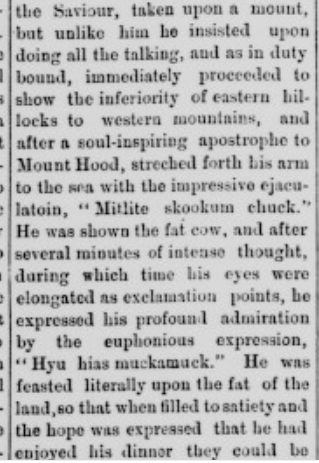

Chinook as a a Classical Dialect.
A Pacific Coaster lately created a
sesation at Coney Island by an oc-
casional use of the classical Chinook
dialect, which was mistaken for San-
scrit [Sanskrit] by many of the delighted Knick-
erbockers, who at once accorded
him the position of a man of educa-
tion and learning. Every syllable
which fell from his lips was greedily
seized upon and treasured up as
were the mystical utterance[s] of the
Delphian oracle. And in the course
of time, by a strict association of
idea with the favorite expressions
used under varying moods, it was
discovered that certain words deno-
ted great approbation, others pro-
found disgust, and still others the
indifference of a Conkling, but fur-
ther than this, no progress was made
in fathoming the unknown tongue.
It was observed that “Konaway hy-
as close,” indicated a very decided
approval, and many were the objects
of exquisite merit shown to our Pa-
cific friend for the sole and express
purpose of hearing that magnificent
sentence roll forth from his stentori-
an lungs, while the reporters stood
with pencils poised to catch its pre-
cise inflection. Then again, objects
calculated to arouse antagonism and
disgust were purposely planned, to
draw forth an expression which, like
the anathema in Latin, should strike
terror to the soul from its thunder-
ing reverberations. “Hyas masat-
che okoke tillicum,” was thus invest-
ed with a profundity of meaning
which we, on Puget Sound, would
consider ridiculously disproportioned
to its literal meaning. He was, like
the Saviour, taken upon a mount,
but unlike him he insisted upon
doing all the talking, and as in duty
bound, immediately proceeded to
show the inferiority of eastern hil-
locks to western mountains, and
after a soul-inspiring apostrophe to
Mount Hood, stre[t]ched forth his arm
to the sea with the impressive ejacu-
latoin [ejaculation], “Mitlite skookum chuck.“
He was shown the fat cow, and after
several minutes of intense thought,
during which time his eyes were
elongated as exclamation points, he
expressed his profound admiration
by the euphonious expression,
“Hyu hias muckamuck.” He was
feasted literally upon the fat of the
land, so that when filled to satiety and
the hope was expressed that he had
enjoyed his dinner they could be
regaled with the sight of his placing
his hands upon a distended stomach
and complacently murmuring “Hyu
k-lam.“But enough examples have been
given to show that our Pacific Coast-
er has had his own time among Co-
ney Islanders, with scarcely any
other requisite than his carefully
guarded and discriminately used
knowledge of Chinook. All hail to
the genius which can attain distinc-
tion and prominence from such un-
expected means! Let not the les-
son be lost, when others of our wide-
awake people visit the unsophistica-
ted regions on the Atlantic sea-
board.
— from the Olympia (Washington Territory) Washington Standard of July 22, 1881, page 2, column 2
Untranslated Jargon in a PNW paper meant that the locals understood it perfectly well. Here’s a guide for those born later:
- Konaway hyas close =
kʰánawi hayas-łúsh =
‘(it’s) all very good’ - Hyas masatche okoke tillicum =
hayas-másáchi úkuk tílixam =
‘that person is very mean’ - Mitlite skookum chuck =
míłayt skúkum chə́qw =
‘there’s some powerful water’ - Hyu hias muckamuck =
háyú háyás mə́kʰmək =
‘lots of big food’ (really) - Hyu k-lam =
háyú t’łám* =
‘lots of clams’

Pingback: 1882, Nebraska: Jargon as an attraction at the Page County Fair | Chinook Jargon