Lempfrit’s legendary, long-lost linguistic legacy (Part 18)
The 18th pair of pages in this precious document again brings us plenty of stuff worth knowing about Chinook Jargon.
(Here’s a link to the other posts in this mini-series.)
Where you see me underlining stuff here, it’s material that was added by the manuscript’s writer HT Lempfrit, from his good personal knowledge of the Jargon.
“[SIC]” shows that someone mis-wrote a word. It wasn’t necessarily Lempfrit, since he was copying from someone else’s manuscript, Modeste Demers’ now-lost original to be exact.
So, where I’m showing differences between Lempfrit & somebody else, it’s Alphonse Pinart’s “Anonymous 1849” copy that I’ve been able to compare with.
Where you see [le]tters in square brackets, they’re not visible on the page copy that I’m working from, but we infer that they really are there!
By the way, the notation ___ means that the preceding entry is repeated in that position, along with some additional word(s).
There aren’t so many new discoveries in today’s installment, but this material does show us nice evidence that complex expressions already existed in early-creolized (southern-dialect) Chinuk Wawa by 1849.
See if you recognize words in these unusual spellings! I think we have a couple more small discoveries today, again showing the value of examining every Chinuk Wawa document — even those that appear to be straight copies of each other!
Kŏpĕt – finir ‘to finish’
(Pinart/Anonymous 1849/RV Grant 1946 also has ‘mettre à fin’ (‘to put to an end’).)
Kilapaye – tourner, virer, verser, revenir ‘to turn, swerve, pour, return’
____ [i.e. kilapaye] naika tomtom – mon coeur est changé ‘my heart has changed’ (‘I’ve changed my mind’)
(Literally, ‘my heart has turned’.)
Mamouk patl – remplir ‘to fill (something)’
(Literally, ‘to make full’.)____ [i.e. mamouk] sel – ensevelir ‘to entomb’
(Literally, ‘to make cloth; to put (someone) into cloth (i.e. burial shroud)’.)
____ metlaït kopa éléhé – enterrer ‘to bury’
(Literally, ‘to cause to be located in the ground; to put into the ground’.)
____ ploum – balayer ‘to sweep (with a broom)’
(Literally, ‘to work (on something) with a broom’.)
____ tlékop wawa – manquer à sa* parole, ne pas suivre les avis d‘un autre ‘to break one’s word; to not follow the advice of someone else’.)
(Seems to be absent from the published Demers-Blanchet-St Onge 1871 dictionary. Literally, ‘to make a word be cut; to cut a word’. Pinart/Anonymous 1849/RV Grant 1946 has ‘…des autres’ (‘…of others’).)
____ klis – graisser ‘to fatten (something)’
(Literally, ‘to make fat’.)
____ issik – avironner ‘to paddle (a boat)’
(Literally, ‘to work with a paddle’.)
____ la lame – ramer ‘to row (a boat)’
(Literally, ‘to work with an oar.’ Here I’m only suggesting a difference between issik & la lame in Jargon — do you have a clear idea that they represent different things? A Wikipedia article tells me ‘oars’ are connected to the vessel, while ‘paddles’ are held in your two hands…)
____ la lime – limer ‘to file (something down)’
(Literally, ‘to use a file (on something)’.)
____ le whet – fouetter ‘to whip (someone)’
(Literally, ‘to use a whip (on someone)’.)
____ pis – pisser ‘to urinate’
(Literally, ‘to make urine’.)
____ kēlălĕ – faire la médecine ‘to do medicine’
____ takoum – lécher ‘to lick’
(Literally, ‘to make licking’.)
____ kwish – refuser quelque chose à quelqu’un pour lui faire honte ‘to refuse something to someone to shame them’
(Literally, ‘to make a sound of refusal’. The published Demers-Blanchet-St Onge 1871 dictionary gives the less culturally informative ‘to refuse unobligingly’.)
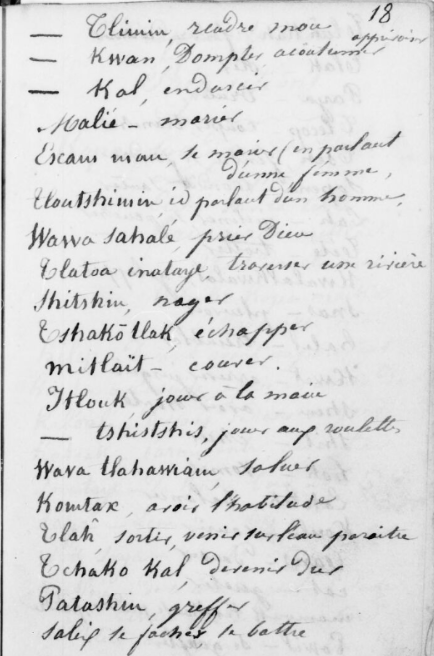
____ tlimin – rendre mou ‘to make soft, to soften (something)’
____ kwan – dompter, acoutumer ‘to tame, accustom’
(Literally, ‘to make tame’.)____ kal – endurcir ‘to make hard, to harden (something)’
____ malié – marier ‘to marry (someone), i.e. to perform a wedding ceremony’
(Literally, ‘to make married’.)Escam man – se marier (en parlant d’une [sic] femme ‘to get married (when speaking of a woman)’
(Literally, ‘to take/pick/choose a man’.)[____] tloutshimin – id[em] parlant d’un homme ‘same thing, speaking of a man’
(Literally, ‘to take/pick/choose a woman’; Pinart/Anonymous 1849/RV Grant 1946 has ‘d[it]to’.)wawa sahalé – prier Dieu ‘to pray (to) God’
(Literally, ‘to talk upwards; to talk to the sky’.)tlatoa inataye – traverser une rivière ‘to cross a river’
(Literally, to go across’.)shitshin [sic] – nager ‘to swim’
tshakō tlak – échapper ‘to escape’
(Literally, ‘to come into view’.)mitlaït – couver* ‘to brood (as a bird sitting on its eggs)’
(This sense is not in the published Demers-Blanchet-St Onge 1871 dictionary. Literally, ‘to sit’.)itlouk [sic] – jouer à la main ‘to play “hand” (the Indigenous stick game)’
[Better known to us in the Chinookan collective-plural form, iłukuma.]____ [i.e. mamouk?] tshistshis – jouer aux roulettes ‘to play “discs” (the Indigenous disc game)’
[Literally, ‘to use discs’. The published 1871 Demers-Blanchet-St Onge dictionary says ‘to gamble with small wheels’.]wava [sic] tlahawiam – saluer ‘to greet’
(Literally, ‘to say hello’.)komtax – avoir l’habitude ‘to have the habit (of)’
(Literally, ‘to know (how to)’.)[i.e. tshako?] tlah̃ – sortir, venir sur l’eau, paraitre ‘to go out, come above the water(‘s surface), (make an) appear(ance)’
[Literally, ~ ‘to become visible; to come out into sight’.]tchako kal – devenir dur ‘to get hard’
patashin* – greffer ‘to graft’
(Seems to be a garbled version of the Chinuk Wawa word meaning ‘to patch (something)’.)salix – se facher, se battre ‘to get angry, to fight’
