‘Ear of corn’ in Jargon?
I’ve shared many corny thoughts here lately.
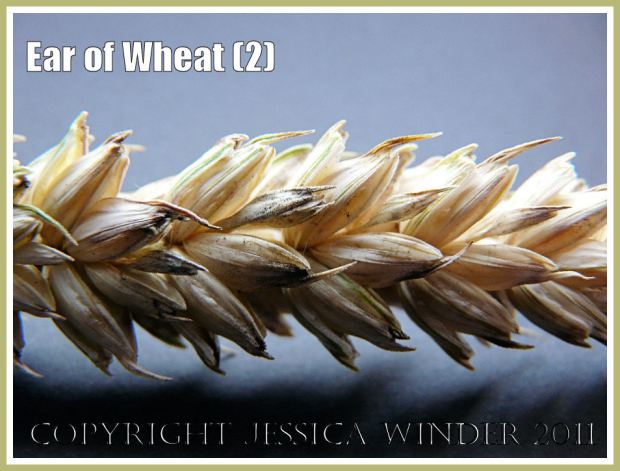
Image credit: Jessica’s Nature Blog
While I was re-reading an early issue of Kamloops Wawa, I noticed the phrase “ears of corn” added in English to a Chinook version of a bible story
Iawa Farao iaka
‘Then Pharaoh’
kopit slip, pi wixt iaka slip, pi iaka nanitsh
‘woke up, and again he slept, and saw’
sinmokst ipi < “ears of corn.” > kopa ixt lipii, pi
‘seven (ears of corn) on one foot*, and’
drit ayu hwit mitlait kopa ukuk sinmokst ipi, pi xlwima
‘quite a lot of wheat was on those seven (ears), and (on) another’
chako sinmokst xlwima ipi, drit aias kaltash, pi
‘grew 7 other (ears), really worthless, and’
klaska makmak ukuk ilip aias tlus ipi.
‘they ate those first, nice (ears).’
These ‘ears of corn’ are obviously wheat ‘ears’ or ‘spikes’. Here, ‘corn’ is the old-fashioned, more British, generic meaning: ‘grain’.
I guess the Chinook newspaper’s French-born editor, Father Le Jeune, wasn’t very so well acquainted with US English. Every time I find the word korn in his Chinook Jargon, it has this same meaning of ‘grain’ in general.
(But, far more common for that meaning is his use of the typical Northern Dialect CJ word, hwit i.e. ‘wheat’.) Nowhere in the north have I found a clear word for ‘maize’, what we call ‘corn’ here in the States.
But whether we’re talking about wheat or corn or other grain, this little word ipi raises a crop of questions…
Did the readers of Kamloops Wawa understand “ipi”?
This ipi is clearly from French épi, a ‘spike’ or an ‘ear’ of a grain-bearing plant. But is this just Father Le Jeune inserting a word of his language when he doesn’t know one in Jargon? He hardly ever did so. But, judging from the rarity and the obscure meaning of korn in Northern Dialect CJ, I’m really curious about this.
Or might this be a locally known Canadian/Métis French word? There were many such around Kamloops.
It’s hard to directly research French Canadianisms sometimes, so I turned to dictionaries of Michif (French-Cree mixed language of the Métis) for clues. There I found nothing like épi; only bledeñd ‘corn; corn cob’, i.e. ear of corn.
How do we say ‘ears of corn’ etc. in Chinook Jargon?
This clicks with my intuition that we’d just say ixt isałx̣ in Jargon, literally ‘one corn’, when we’re talking about maize a.k.a. Indian corn. But I’ve found no guidance in any existing dictionaries or texts.
