1858: There was more Jargon on the overland route to the Fraser gold rush…
…Than there was on the maritime & riverine route.
In a BC gold rush report (from the Thompson River this time), the Dalles, Oregon, based prospector party of a David McLaughlin runs into “trouble” — or justified opposition to invasion by 160 (!) foreigners — from Syilx (Okanagan) tribal people.

Angus McDonald (image credit: Wikimedia Commons)
This interests me enormously for what it shows of Indigenous BC people’s Chinuk wawa knowledge at the time the gold rush brought a sudden flood of non-Natives.
Syilx territory is inland, on both sides of the modern Canada-US border, east of the Cascades Mountains.
We mostly hear of the gold rushers coming via the coast, up the Fraser River, so it’s useful to get a comparison with the overland route north from Oregon and Washington Territories.
Another known historical fact is that the Syilx and other tribes of the middle to upper Columbia River region had already been angry for at least 3 years about newcomers trespassing into their lands to take gold or anything else without permission.
In the article about McLaughlin’s efforts and his death, we hear that a Mr. Wolff associated with Hudson’s Bay Company Fort Colvile was advising gold rushers they risked being killed by the area’s Native people.
McLaughlin’s group is said to have included, among others, Californians and an Irishman, with only one person from [Fort] Vancouver being mentioned. So it sounds like knowledge of Chinook Jargon must have been far from universal among this bunch.
Here’s one clue to the level of communication achieved between the Syilx folks and these gold rushers:
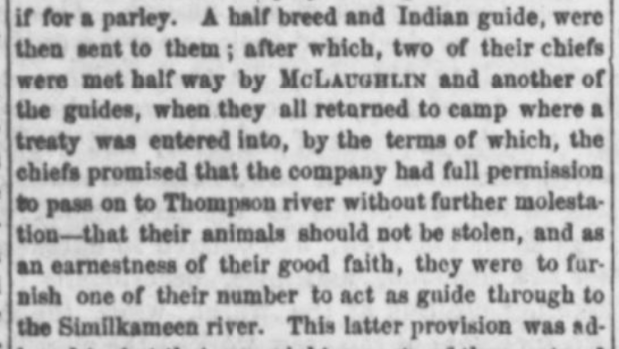
A half breed and Indian guide, were
then sent to them; after which, two of their chiefs
were met half way by McLAUGHLIN and another of
the guides, when they all returned to camp where a
treaty was entered into, by the terms of which, the
chiefs promised that the company had full permission
to pass on to Thompson river without further molesta-
tion — that their animals should not be stolen, and as
an earnestness of their good faith, they were to fur-
nish one of their number to act as guide through to
the Similkameen river.
And this, involving the intercession of a veteran HBC honcho, Angus McDonald:
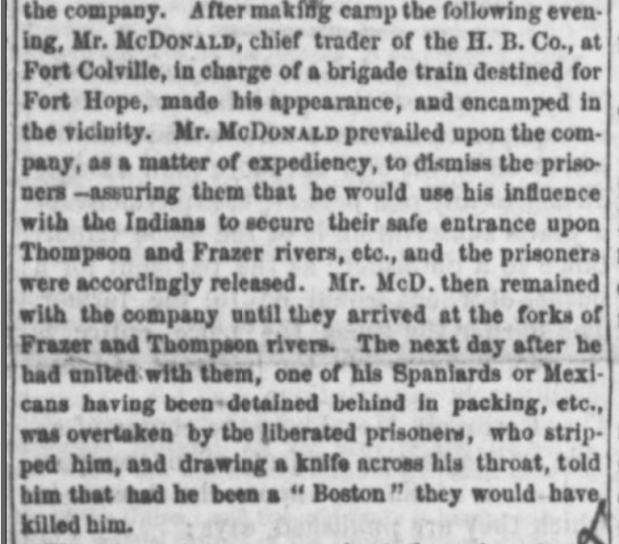
After making camp the following even-
ing, Mr. McDONALD, chief trader of the H. B. Co., at
Fort Colville, in charge of a brigade train destined for
Fort Hope, made his appearance, and encamped in
the vicinity. Mr. McDONALD prevailed upon the com-
pany, as a matter of expediency, to dismiss the priso-
ners — assuring them that he would use his influence
with the Indians to secure their safe entrance upon
Thompson and Frazer rivers, etc., and the prisoners
were accordingly released. Mr. McD. then remained
with the company until they arrived at the forks of
Frazer and Thompson rivers. The next day after he
had united with them, one of his Spaniards or Mexi-
cans [note Chinook Jargon spayol ‘Mexican’] having been detained behind in packing, etc.,
was overtaken by the liberated prisoners, who strip-
ped him, and drawing a knife across his throat, told
him that had he been a “Boston” they would have
killed him.
Lastly, this reported communication:

The trail between Fort Okanagan
and Thompson river, they found pretty rough for the
most part. There is a good route from Fort Okana-
gan to Thompson river, nearer by more than one-half,
which the Indians spoke of, but refused to conduct
the company to it, or by way of it.
— all from the Olympia (Washington Territory) Pioneer and Democrat of September 10, 1858, page 2, column 6
I infer that there was enough Chinuk Wawa knowledge in this interior region, in tandem with chains of translation using already established fur-trade era relationships, for a good deal of mutual understanding to take place.
Contrast this with the situation, not very far away, on the lower Fraser River, where lots of newcomers flooded in without previous experience or language knowledge, and without the benefit of fur-company help.
Final note: the newly borrowed Spanish word “canyon”, not yet standardized in English, is spelled “canion” every time it’s used in the McLaughlin article.

