1892: A startling story
Rumors got lots of play, it seems, in frontier-era Alaska, but calmer heads questioned them.
Here’s one treatment of a false report that the well-known missionary Sheldon Jackson had been killed by Native people he was trying to convert.

Image credit: Amazon
Other parts of the same newspaper page suggest the victim was a Rev. John Edwards, which I take to actually be the Quaker missionary Charles H. Edwards — whose killing involved whiskey smugglers.
The story prominently involves Chinook Jargon, including the famous word “hoochinoo”, sourced from Tlingit, which we still use in a truncated form, “hooch“.
And it accurately represents the degree of acculturation, both linguistic and otherwise, among the Lingít people in 1892.
Read on, my friend:

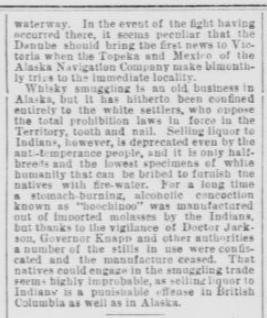
THE STORY DOUBTED.
Reasons Which Cause It to Be Dis-
credited.There is every probability of the first
dispatch printed above being exaggerated,
As the steamer Danube of the Cana-
dian Pacific Navigation Company only runs
as far north as Fort Simpson, B. C., some
500 miles south of the scene of the alleged
tragedy, and communications from the
north could only come through straggling
Indian canoeists or a stray white pros-
pector.There are three prominent aboriginal
races in Alaska, viz: the Eskimos, Thlin-
kets [Lingít] and Haidas. The Thlinket race is the
one occupying the country from Yakutat,
near Mount St. Elias, down to a few hun-
dred miles south of Juneau. The members
of this race are all more or less civilized,
wear white men’s apparel and can nearly
all talk Chinook and a little English. For
the past eight or 10 years they have been
peaceably disposed to the “Boston men,”
as the white people are called, and are em-
ployed very largely in the mines, sawmills
and canneries there.The particular tribes living within a
radius of 25 miles of Juneau are known as
the Auk[e]s and the Yakus [Takus?], but had any
trouble occurred with either of these tribes
it is altogether improbable that Dr. Jack-
son would have gone among them on such
an errand without white aid from Juneau
or from Douglas Island, a settlement near
the famous Treadwell mine, four miles from
Juneau and separated by a body of water
called Gastin[e]au channel.If, however, as the first dispatch says, the
trouble was among the Yukon Indians, the
scene of the fray must have been at Chilcat
or Chilcoot Indian villages. at least 200
miles north of Juneau, where the miners
going into the Yukon River procure pro-
visions and carriers to help them across the
30-mile divide that lies between the coast
and the lakes at the head of Alaska’s great
waterway. In the event of the fight having
occurred there, it seems peculiar that the
Danube should bring the first news to Vic-
toria when the Topeka and Mexico of the
Alaska Navigation Company make bimonth-
ly trips to the immediate locality.Whisky smuggling is an old business in
Alaska, but it has hitherto been confined
entirely to the white settlers, who oppose
the total prohibition laws in force in the
Territory, tooth and nail. Selling liquor to
Indians, however, is deprecated even by the
anti-temperance people, and it is only half-
breeds and the lowest specimens of white
humanity that can be bribed to furnish the
natives with fire-water. For a long time
a stomach-burning, alcoholic concoction
known as “hoochinoo” was manufactured
out of imported molasses by the Indians,
but thanks to the vigilance of Doctor Jack-
son, Governor Knapp and other authorities
a number of the stills in use were confis-
cated and the manufacture ceased. That
natives could engage in the smuggling trade
seems highly improbable, as selling liquor to
Indians is a punishable offense in British
Columbia as well as in Alaska.
— from “A Startling Story”, in the San Francisco (CA) Morning Call of May 29, 1892, page 8, columns 1-2
