Klamath-language ‘corn’ is another Jargon loan?
Previously here, I’ve shown how southwest Oregon’s ʔewksgiˑsam hemkanks (Klamath language) is an example of another language (Canadian/Métis French) being preserved indirectly.
There’s a pretty big number of French words preserved in Klamath — definitely more than you’d find if it were due only to Chinuk Wawa’s influence.
Today I’d like to show you a Klamath word that the speakers have considered to be a preservation of a borrowing from the unrelated Shasta language. (That link takes you to Shirley Silver’s dissertation, downloadable for free.)
However, I suspect it’s really either a Chinookan loanword, or else one from Chinook Jargon.
Here’s what I’m referring to, from M.A.R. Barker’s “Klamath Dictionary” (downloadable for free):

?isalq’i 3Sn corn (maize). Also ?isalq (BL). This was said to be a Shasta word.
?isalq’i : /?isalq’i/ corn. BL gave ?isalq : /?isalq/.
This word ʔisalq̓i ~ ʔisalq is easily recognizable as Chinook Jargon’s isáłx̣ ‘corn’.
By the basic principles of historical linguistics, we conclude that isáłx̣ is native to Chinookan. One huge reason: The meaning in Chinookan, and only in Chinookan, is demonstrably a name for a native plant, kinnikinnick a.k.a. bearberry a.k.a. Arctostaphylos uva-ursi.
It stands to reason that this word’s meaning got extended by Lower Chinookans quite early in the era of contact with Euro-Americans to ‘maize a.k.a. corn’.
Let’s pause a moment to reflect on what the color(s) of that circa 1800 trade corn must have been…was it a reddish variety?

Image credit: Bonner County Daily Bee
Kinnikinnick berries aren’t the yellow that we nowadays associate with corn. Here’s a sample of some corn colors that might have been seen in the Pacific Northwest 2 centuries ago:
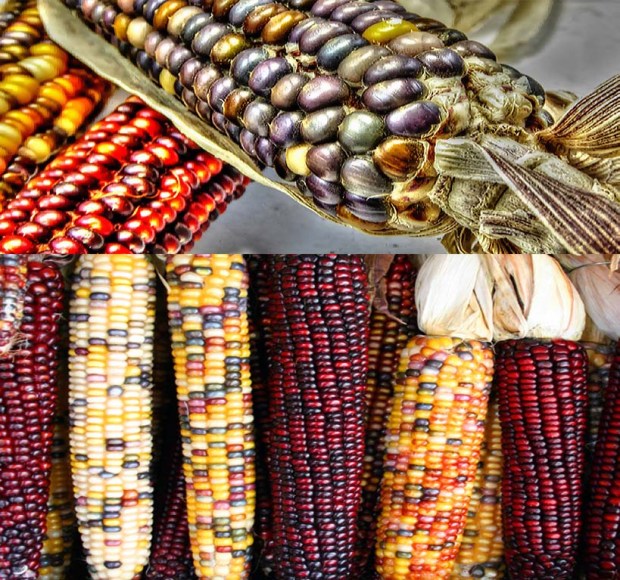
Heritage (“Indian”) corn varieties (image credit: MySeeds)
I’m no expert on Klamath, but the final -i on one variant of this word seems to a common Klamath-internal phenomenon. Lots and lots of words end in -y / -i. So that’s some more evidence for the “borrowed item” status of this ‘corn’ word in Klamath.
