1918, Alaska: Last chieetain [SIC] passes away
An Alaska Native leader is remembered for his love of Chinuk Wawa…
He must have picked it up around the time Alaska was handed from Russian to US control (1867).
Previous research has shown me that that’s when the Jargon began to appear in use in Alaska.
Previous to that, some of the farthest southeast Alaskan tribes such as the Lingít (“Tlingits”) had been known to travel to Victoria, BC, where the waterfront hosted a longtime intertribal community that used Chinook Jargon heavily.
It’s just that the Jargon, for Indigenous people, was much more useful with English-speakers, large numbers of whom were bilingual in it.
Russians, as a rule, had not had any reason to learn Chinuk Wawa.
From 1867 onwards, US military and commercial presence blossomed, primarily in the “Panhandle” of southeast Alaska.
That’s why the Jargon caught on all of a sudden.
A corollary of this is, the famous “skookum papers” of southeast Alaska began to be written in that era.
Here’s a local newspaper’s mostly sympathetic, but not surprisingly also racist (“last of his tribe” is always a signal), remembrance of the recently deceased chief whose name Settlers spelled as An-A Kla-Hash or Ano-Thlosh:
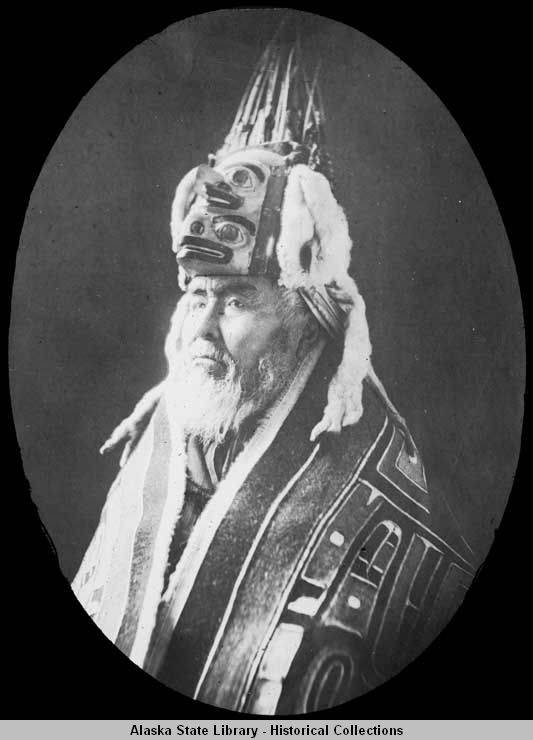
The postcard of “Ano-Thlosh, Chief of the Taku Tribe of Thlinght [Tlingit] natives. Copyright 1906.” Image credit: Alaska’s Digital Archives
asdf
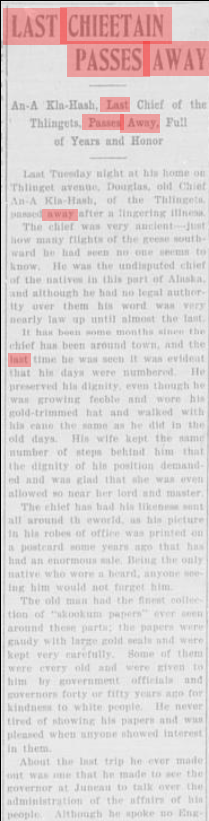

LAST CHIEETAIN [chieftain]
PASSES AWAYAn-A Kla-Hash, Last Chief of the
Thlingets, Passes Away, Full
of Years and HonorLast Tuesday night at his home on
Thlinget avenue, Douglas, old Chief
An-A Kia-Hanh, of the Thlingets,
passed away after a lingering illness.The chief was very ancient — just
how many flights of the geese south-
ward be had seen no one seems to
know. He was the undisputed chief
of the natives in this part of Alaska,
and although he had no legal author-
ity over them his word was very
nearly law up until almost the last.It has been some months since the
chief has been around town, and the
last time be was seen it was evident
that his days were numbered. He
preserved his dignity, even though he
was growing feeble and wore his
gold-trimmed hat and walked with
his cane the same as he did in the
old days. His wife kept the same
number of steps behind him that
the dignity of his position demand-
ed and was glad that she was even
allowed so near her lord and master.The chief has had his likeness sent
all around the world, as his picture
in his robes of office was printed on
a postcard some years ago that has
had an enormous sale. Being the only
native who wore a beard, anyone see-
ing him would not forget him.The old man had the finest collec-
tion of “skookum papers” ever seen
around these parts: the papers were
gaudy with large gold seals and were
kept very carefully. Some of them
were very old and were given to
him by government officials and
governors forty or fifty years ago for
kindness to white people. He never
tired of showing his papers and was
pleased when anyone showed interest
in them.About the last trip he ever made
out was one that he made to see the
governor at Juneau to talk over the
administration of the affairs of his
people. Although he spoke no Eng-
lish, he talked Chinook, the traders’
language that is spoken only by the
older Alaskan Indians, and he was
always pleased if be could get some
one to converse with him in that lan-
guage.The chief was well to do — he had
never worked it his life, but had
property that brought him an in-
come and at one time received a pen-
sion from one of the mining com-
panies for his good will with the
other natives.Seyeral years ago he abdicated
his powers to a relative — that is, the
active powers — but he still main-
tained the dignity and the name. He
is survivied [SIC] by many relatives, and
the flags on all the native houses and
boats are flying at half mast in his
honor.The Channel Band was hired to
meet the 2:30 ferry this afternoon
Is Juneau to escort the body of the
dead chief from the boat that
brought the body from Douglas, to
the Juneau cemetery. It is thought
that the burial at Juneau will be
but temporary and that the chief
will rest finally with his fathers at
Klukwan.
— from the Douglas Island (AK) News of October 11, 1918, page 1, column 5
