Still more about “Cayuse French”!
A decade ago in this space, I wrote “Cayuse French, It’s a Thing“. I gave examples from books.

“Cayuse” was also a word of local Chinook Jargon, sometimes erroneously thought to have come from French (image credit: Wikipedia)
Here’s a whole bunch more that the people of the Northwest have said about Métis/Canadian French spoken among them:

Angered by the knowledge that it bad
been deprived of a sensational article, the
Inter Mountain sought at first to insult
the dead, and finding its material short,
attacked the living by the use in its article
of the insulting and uncalled for term cay-
use French.”
— from the Butte (MT) Miner of Jan 12, 1889, page 4, column 2
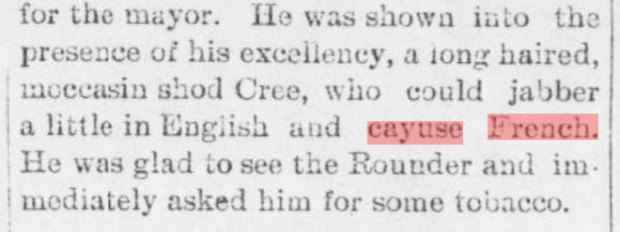
He was shown into the
presence of his excellency, a long haired,
moccasin shod Cree, who could jabber
a little in English and cayuse French.
He was glad to see the Rounder and im-
mediately asked him for some tobacco.
— from the Dupuyer (MT) Acantha of December 07, 1899, page 5, column 3
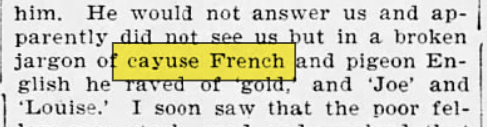
He would not answer us and ap-
parently did not see us but in a broken
jargon of cayuse French and pigeon En-
glish he raved of ‘gold, and ‘Joe’ and
‘Louise.’
— from the Butte (MT) Daily Post of July 27, 1901, page 14, column 2

Anybody who beats that parody will
have to step some. Still, we hope
everybody tries. We suggest a parody
in the German style and one in “cay-
use” French.
— from the Missoula (MT) Missoulian of February 2, 1922, page 4, column 6

Lew Sarett entertained a small au-
dience at the high school auditorium
last night with readings from his
poems and stories in French-Canadian
dialect better known to Missoulians
as “cayuse French.”
— from the Missoula (MT) Missoulian of June 6, 1922, page 2, column 2
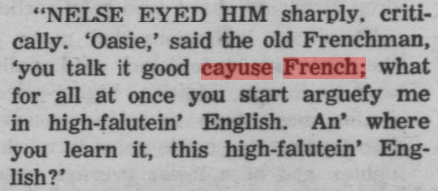
“NELSE EYED HIM sharply, criti-
cally. ‘Oasie,’ said the old Frenchman,
‘you talk it good cayuse French; what
for all at once you start arguefy me
in high-falutein’ English. An’ where
you learn it, this high-falutein’ Eng-
lish?’
— from the Great Falls (MT) Montana Farmer-Stockman of December 01, 1961, Page 18, column 3
Bonus fact:
The Wikipedia article on “Cayuse Horse” claims:
In British Columbia, the variant word cayoosh refers to a particular breed of powerful small horse admired for its endurance. Qayus (Cayuse) is the Tŝilhqot’in term for the wild horses in that Province’s Chilcotin region, used by the local Tŝilhqot’in Nation.[2] [3]
The footnotes there cite, respectively, a dead link to APTN’s “The Wild Ones” and “First Voices: Tsilhqot’in (Xeni Gwet’in)”. At the latter, I’m unable to find any words for ‘horse’, ‘pony’, ‘wild’, or any other entry that would seem to match the supposed qayus.
However, it’s easy to use Google and find out there really is a place called the ?Elegesi Qayus Wild Horse Preserve in BC.
And because qayus is very different from the native Tŝilhqot’in-language term lhiny for ‘horse’, I take it as a borrowing from Chinuk Wawa.
Neat!

I’ve learned “arguefy”, and I’ll try really hard to revive it!!!
LikeLiked by 1 person
It’s the real McCoy; see argufy, v. in Jonathan Green’s Dictionary of Slang website.
All this Montenna talk’s got me sidetracked rememberin’ my Lincoln County mom’s turns of phrase!
LikeLike