1905, Chemawa, OR: Indian school closing
“Indian School Closing”, says the headline, but it’s just about a graduation day at Chemawa.
“Salem Training School Has Excellent Programs — Notes on Commencenent [SIC] Day” is the sub-header.
I mean no disrespect to the young graduates in focusing here on the frontier-era reminiscences of a couple of Settler oldtimers, sharing some Chinuk Wawa scraps with us.
Both men use a greeting < klaheim >, indicating what we know as the local, Grand Ronde usage, łax̣áyam, rather than the general Settler “klahowya“. Neat.
Both are very typically White, though, in assigning < klaheim > a translation as the English-speaking greeting “good day”. This distortion explains why one of these guys has a Native person of the past supposedly responding with < Nawitka >, “certainly”. Yikes.
W.D. Claggett (1840-1911) was the son of Charles Claggett, both pioneers of 1852.
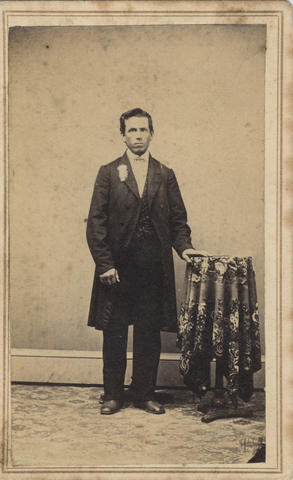
William D. Claggett (image credit: Oregon Historical Society)
John Minto (1822-1915) was a well-known England-born pioneer of 1845.
Well, here’s your bite-sized serving of Grand Ronde Chinook Jargon for today:
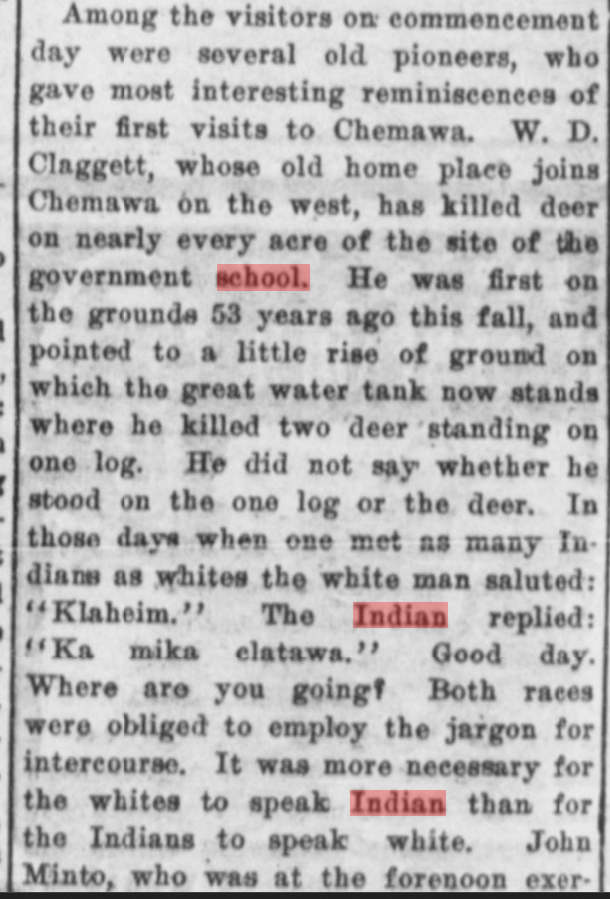
…Among the visitors on commencement
day were several old pioneers, who
gave most interesting reminiscences of
their first visits to Chemawa. W. D.
Claggett, whose old home place joins
Chemawa on the west, has killed deer
on nearly every acre of the site of the
government school. He was first on
the grounds 53 years ago this fall, and
pointed to a little rise of ground on
which the great water tank now stands
where he killed two deer standing on
one log. He did not say whether he
stood on the one log or the deer. In
those days when one met as many In-
dians as whites the white man saluted:
“Klaheim.” The Indian replied:
“Ka mika clatawa.” [meaning:] Good day.
Where are you going? Both races
were obliged to employ the jargon for
intercourse. It was more necessary for
the whites to speak Indian than for
the Indians to speak white. John
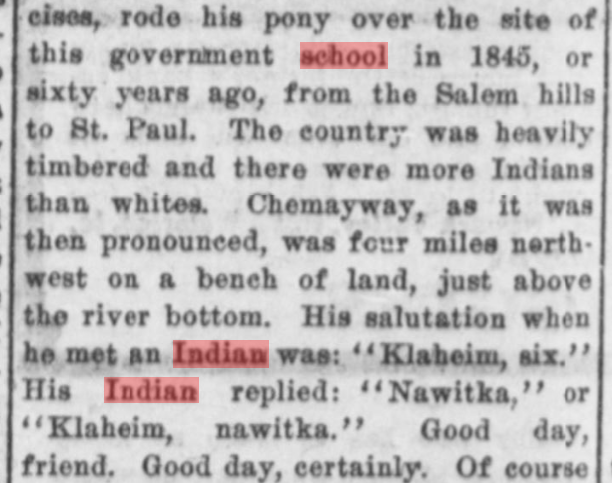
Minto, who was at the forenoon exer-
cises, rode his pony over the site of
this government school in 1845, or
sixty years ago, from the Salem hills
to St. Paul. The country was heavily
timbered and there were more Indians
than whites. Chemayway, as it was
then pronounced, was four miles north-
west on a bench of land, just above
the river bottom. His salutation when
he met an Indian was: “Klaheim, six.“
His Indian replied: “Nawitka,” or
“Klaheim, nawitka.” [meaning:] Good day,
friend. Good day, certainly.
— from the Salem (OR) Daily Capital Journal of August 16, 1905, page 3, columns 3-4
