Ballast Island’s enduring connections with Chinuk Wawa
The other day, I wrote about discovering another intertribal waterfront community, Ballast Island on the Seattle waterfront, that seemed to be consistently connected with Chinuk Wawa…
Now I’d like to show what has turned up in my research into that question.
The clear trend of the evidence is that Ballast Island was for several years both an Indigenous village and a crossroads for Native people visiting Seattle and beyond on business. And Chinook Jargon was very much in use at that place, making it very similar to the better-known Victoria, BC waterfront that gave us so many songs and stories.
Here’s a selection of clippings to demonstrate what I’m saying:
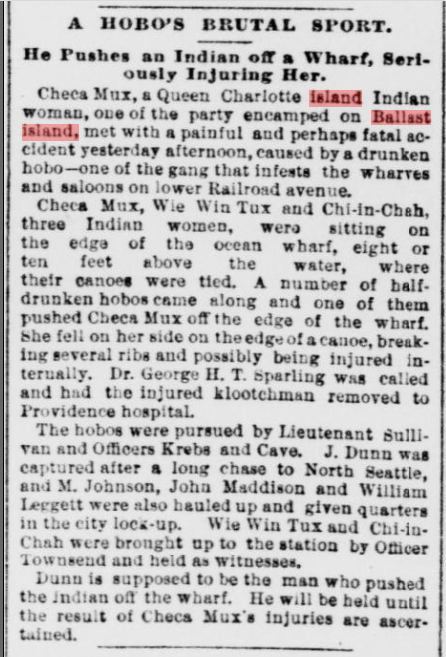
A HOBO’S BRUTAL SPORT.
He Pushes an Indian off a Wharf, Seri-
ously Injuring Her.Checa Mux, a Queen Charlotte island Indian
woman, one of the party encamped on Ballast
island, met with a painful and perhaps fatal ac-
cident yesterday afternoon, caused by a drunken
hobo — one of the gang that infests the wharves
and saloons on lower Railroad avenue.Checa Mux, Wie Win Tux and Chi-in-Chah,
three Indian women, were sitting on
the edge of the ocean wharf, eight or
ten feet above the water, where
their canoes were tied. A number of half-
drunken hobos came along and one of them
pushed Checa Mux off the edge of the wharf.
She fell on her side on the edge of a canoe, break-
ing several ribs and possibly being injured in-
ternally. Dr. George H. T. Sparling was called
and had the injured klootchman removed to
Providence hospital.The hobos were pursued by Lieutenant Sulli-
van and Officers Krebs and Cave. J. Dunn was
captured after a long chase to North Seattle,
and M. Johnson, John Maddison and William
Leggett were also hauled up and given quarters
in the city lock-up. Wie Win Tux and Chi-in-
Chah were brought up to the station by Officer
Townsend and held as witnesses.Dunn is supposed to be the man who pushed
the Indian off the wharf. He will be held until
the result of Checa Mux’s injuries are ascer-
tained.
— from the Seattle (WA) Post-Intelligencer of September 22, 1891, page 4, column 3

Important News From New York.
New York Sun, on Editorial Page, Sept. 16.
The Chinook Indians have been the hop pick-
ers in the state of Washington until this year,
when gangs of Chinamen have been hired for
service in the hop ranches. Eighty-seven
canoes, carrying many hundreds of bucks and
squaws all ready to begin hop picking, recently
arrived at Ballast island, and great was the grief
of the red Americans upon finding that Chins-
men had been engaged to do their favorite au-
tumn work. They took to their canoes and
went back to their reservation with empty
money bags.
— from the Seattle (WA) Post-Intelligencer of September 23,1891, page 4, column 3
TYEE PETER S OFFER.
He Wants to Help Fight the
Chileans.GRANDSON OF CHIEF SEATTLE.
Visit to the City of the Tulalip Chief
With His Six Siwash Wives — Ha-
rangue In Chinook.“Tyee Peter” is a well-built, gray-
haired Indian of uncertain age who is at
present living in a tepee on Ballast island
with his six wives and twelve children.
He is chief of the Neah bay and Tulalip
Indians, numbering about 500 braves, and
his home is at Neah bay. He was at police
headquarters a few days ago, and obtained
permission from the chief to remain on the
island until the arrival of his son, “Sleepy
Jack,” with the family schooner, when all
will return home. The old Indian had
been in the city two days, having come
down to do his season’s trading.“Tyee Peter” is a grandson of Chief Se-
attle, whose daughter Clara was Peter’s
mother. He is a very interesting charac-
ter. His mouth resembles that of a Cape
Ann codfish and his head is as large as a
half bushel measure. He is highly of-
fended at the attitude maintained by the
boastful Chileans toward the United
States, and he is anxious to volunteer his
services and that of his 500 braves in the
event of war. When he was at police
headquarters several of the officers who
speak Chinook told him all about the
Chilean difficulty, and he was very much
in earnest about arranging for his follow-
ers to take a hand in the fight.There are about thirty Indians — men,
women and children — encamped on Ballast
island, and yesterday afternoon “Tyee
Peter” entertained them with a long
harangue. The pow-wow lasted several
hours, and when it broke up the ten or
twelve braves, who composed the encamp-
ment, were so much excited they nearly
had a war-dance. The old chief spoke in
Chinook. He worked himself into a
frenzy and gave the Chileans hail Colum-
bia in about this strain:“Uncle Sam has been very good to my
people — of the Neah bay and Tulalip. We
must repay him. Hyas Boston man (chief
of police) tells me that the Chileans,
southern Indians, have killed some of
Uncle Sam’s sailors, and have insulted the
white people. There will be war. Shall
we fight? We must! I will offer Uncle
Sam our services — 6oo fearless men — and
who then can stand against us? We could
butcher the Chileans in one day; we
would go to camp at night with a thousand
scalps at our waists; their squaws would
be our slaves and their houses would be
theirs no ionger; we are but a handful,
but we are brave and can fight; they are
many, but they are savage and are cow-
ards; we can whip them! Shall we go?”And every buck within hearing jumped
to his feet and with a war.whoop [sic], yelled
the affirmative response:“Nawitka!”
“Tyee Peter” was very anxious to join
General O. O. Howard’s forces and fight
the Nez Perces during the Indian wars,
and a good story is told concerning an
interview that he had with the brave
general.“Tyee Peter” had over 700 braves in 1881,
all of whom were aching for a fight; they
wanted to scalp someone and didn’t care
whom. He determined to offer himself
and tribes to General Howard to be used
against the warlike Nez Perces. He com-
municated his resolution to the general
and the hour was set when the interview
should take place. The old chief was on
hand several hours before the appointed
time, and he became very uneasy as the
hours dragged on. The suspense on his
nerves was more than he could bear and
he sought relief in a pint bottle
of whisky. The effect was electrical.
When at last he was marched into
the august presence of the great soldier he
was so drunk that it required two soldiers,
one at each arm, to aid him in keeping his
feet. He stammered out his mission, and
the general scowled with disgust and dis-
favor, and then asked:“Where do you live?”
“Port Townsend.”
“Are you married?”
“Yes— got five wives,” and he braced up
proudly.“We!!, Peter, you go back to Port Town
send and look after your wives.[“]“Tyee Peter” was marched out by two
soldiers, who mercilessly dumped him into
a badger hole, where he lay until he was
sober. He was very much chagrined at
the failure of his mission, and has had but
a poor opinion of General Howard ever
since. Commenting on the incident after-
ward, he said, with a grunt:“He thought I was a squaw; ugh!”
He promises to let people know what he
can do, however, if Uncle Sam sends him
to Chile.,
— from the Seattle (WA) Post-Intelligencer of January 24,1892, page 15, column 3

The encampment of Indians on Ballast island attracted a great deal of attention yesterday…
STEAMER REPORTED LOST.
Indian Tells of Disappearance of a Sup
posed Smuggler Down Sound.An old Indian who sails under the
name of “Siwash Moses” arrived at Bal-
last island yesterday from Whatcom. He
came all the way in a small open canoe
and brought news of a sensational char-
acter concerning the loss of an unknown
steamer, which is supposed to have been
blown up near Point Partridge last Thurs-
dav night while crossing the straits.The Indian says that he was told by an-
other Indian named “Jim,” whose home
is on San Juan island, that a steamer of
about six tons burden, supposed to be a
smuggler, was sunk about four miles from
shore and all on board were lost. He told
the story in Chinook, as follows:Thursday night about 9 o’clock, while “In-
dian Jim” was making his way north from Ad-
miralty head in a canoe, his attention was at-
tracted by a small propeller steamer, which was
steaming towards Victoria about four and one
half miles to the north and west from the shore.
The sea was very calm in shore, where the In-
dian was leisurely propelling his canoe, but
quite a high wind was blowing from land, and
the steamer could be seen tossing with the
waves. The night was clear, and the volume of
smoke from the small vessel stood out in bold
relief against the sky.While the Indian was still watching the
steamer the volume of smoke was suddenly
broken off. and that which still floated upward
spread and soon disappeared. For a
moment there was a cloud of
steam, and when the steam disappeared
there was no steamer: to the right and left not
a sign of the boat which but a moment before
was so plainly visible. The distance was too
great and the wind too high to admit of the In-
dian hearing a sound from the direction in
which he strained his eyes. He firmly believes
that the steamer which he saw was blown up.An old sailor, who has lived on the
Sound for many years, and who inter-
preted “Siwash Moses’ ” story, said:The steamer must have been a smugger, for,
if she had been engaged in a legitimate busi-
ness, her absence since Thursday would have
caused concern and the matter would have
been reported.
— both articles from the Seattle Post-Intelligencer of March 28, 1892, page 8, column 4
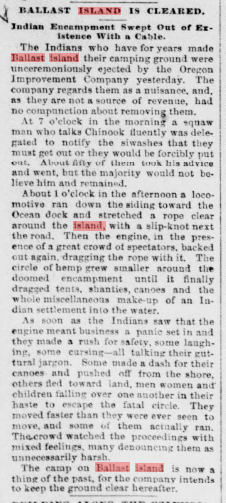
BALLAST ISLAND IS CLEARED.
Indian Encampment Swept Out of Ex-
istence With a Cable.The Indians who have for years made
Ballast island their camping ground were
unceremoniously ejected by the Oregon
Improvement Company yesterday. The
company regards them as a nuisance, and,
as they are not a source of revenue, had
no compunction abont removing them.At 7 o’clock in the morning a squaw
man who talks Chinook fluently was dele-
gated to notify the siwashes that they
must get out or they would be forcibly put
out. About fifty of them took his advice
and went, but the majority would not be-
lieve him and remained.About 1 o’clock in the afternoon a loco-
motive ran down the siding toward the
Ocean dock and stretched a rope clear
around the island, with a slip-knot next
the road. Then the engine, in the pres-
ence of a great crowd of spectators, backed
out again, dragging the rope with it. The
circle of hemp grew smaller around the
doomed encampment until it finally
dragged tents, shanties, canoes and the
whole miscellaneous make-up of an In-
dian settlement into the water.As soon as the Indians saw that the
engine meant business a panic set in and
they made a rush for safety, some laugh-
ing, some cursing — all talking their gut-
tural jargon. [This may mean tribal languages.] Some made a dash for their
canoes and pushed off from the shore,
others fled toward land, men women and
children falling over one another in their
haste to escape the fatal circle. They
moved faster than they were ever seen to
move, and some of them actually ran.
The crowd watched the proceedings with
mixed feelings, many denouncing them as
unnecessarily harsh.The camp on Ballast island is now a
thing of the past, for the company intends
to keep the ground clear hereafter.
— from the Seattle Post-Intelligencer of April 1, 1892, page 8, column 1
Indian Hop Pickers Returning.
The British Columbia Indians who came
over here to pick hops are returning to
this city, a party now being camped on
Ballast Island. They say that they picked
hops one week and that “lots Boston men
pick.” They intend to return home on the
City of Kingston on Monday.
— from the Seattle Post-Intelligencer of September 24, 1893, page 8, column 4
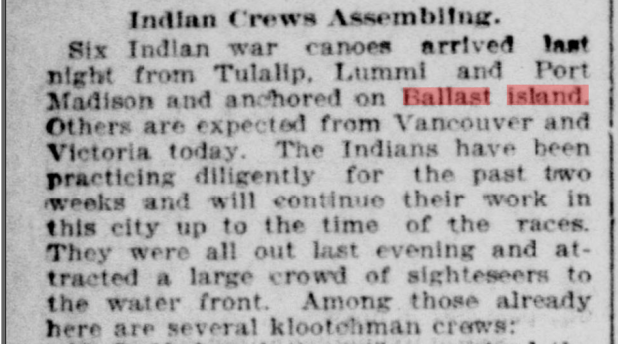
Indlan Crews Assembling.
Six Indian war canoes arrived last
night from Tulalip, Lummi and Port
Madison and anchored on Ballast island.
Others are expected from Vancouver and
Victoria today. The Indians have been
practicing diligently for the past two
weeks and will continue their work in
this city up to the time of the races.
They were all out last evening and at-
tracted a large crowd of sighteseers to
the water front. Among those already
here are several klootchman crews…
— from the Seattle (WA) Post-Intelligencer of July 3, 1895, page 8, column 1
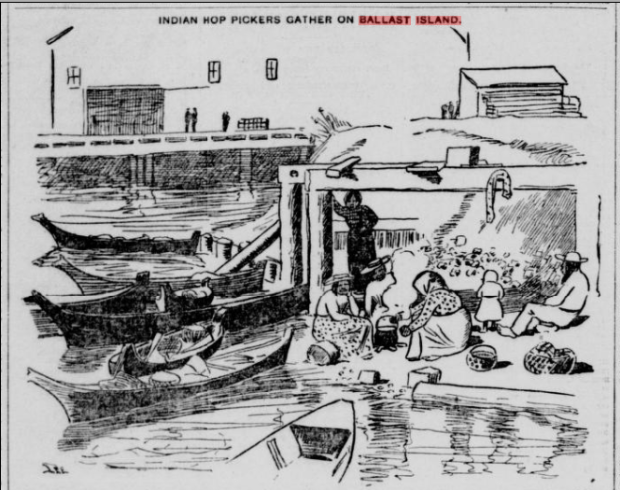

The hop-picking season Is at hand, and
from far and near the people who earn an
annual stipend from the fields are begin-
ning to gather for their labors. If an art-
Ist or a story writer could visit these
scenes of busy and picturesque activity he
would find abundant material for sketch
work such as has given life to the cran-
berry marshes, the sumac gatherers and
the strawberry pickers. Perhaps, nowhere
else in all the Pacific Northwest Is there
a more interesting group of figures thanthe Indians who gather annually at Ballast
Island, on the Seattle water front, to cull
the fruitful rows with which that section
teems. So long have they been beaching
their canoes in the Iate summer time along
those coves and quiet nooks that the old
settlers have come to look forward to their
annual pilgrimage as a matter of course,
and to accord them the same right-of-way
In the hop flelds that the negroes are con-
ceded among the cotton bolls of the South.
The above cut gives a striking and life-like
Illustration of a group of these aborigines
Just landed from their canoes, which liefloating in the water. The bowed figure
and hooded head of the woman who bends
over the steaming kettle, the recumbent
form of the brave as he stretches his bare
toes In the warm sand, the toddling
pappoose who turns his back and waddles
away to play with the sea shells, all these
form a part of the vanishing life of the
Pacific Northwest that ought to be pre-
served In song or story of sketch, and the
Post-Intelligencer takes pleasure in adding
it to the store of marine and agricultural
pictures which it has accumulated since its
art department was established.
— “Indian Hop Pickers Gather on Ballast Island“, in the Seattle (WA) Post-Intelligencer of August 25, 1897, page 8, columns 2-4
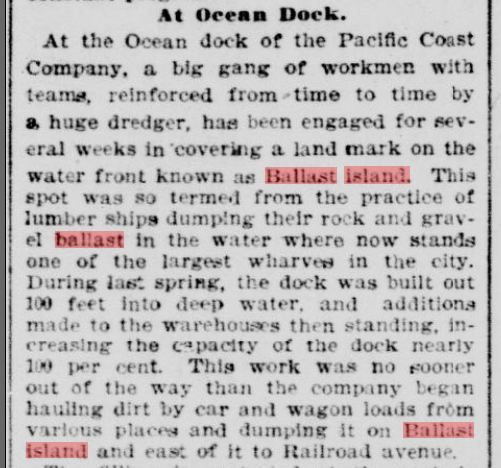
At Ocean Dock.
At the Ocean dock of the Pacific Coast
Company, a big gang of workmen with
teams, reinforced from time to time by
a huge dredger, has been engaged for sev-
eral weeks in covering a land mark on the
water front known as Ballast island. This
spot was so termed from the practice of
lumber ships dumping their rock and grav-
el ballast in the water where now stands
one of the largest wharves in the city.
During last spring, the dock was built out
100 feet into deep water, and additions
made to the warehouses then standing, in-
creasing the capacity of the dock nearly
100 per cent. This work was no sooner
out of the way than the company began
hauling dirt by car and wagon loads from
varlous places and dumping it on Ballast
island and east of it to Railroad avenue.
— from the Seattle (WA) Post-Intelligencer of July 12, 1898, page 6, column 3
By February 16, 1900, it’s reported that the former Ballast Island is the building site of a waiting room “for the comfort of longshoremen”.
In the book “The Siwash” (1895) by JA Costello is the doggerel poem “Indians in the Hop Fields” on page 162:
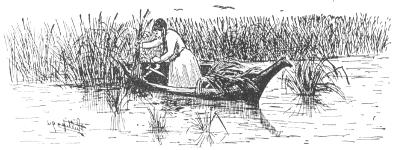
“KLOOTCHMAN GATHERING RUSHES”, from page 161
There’s dusky maidsIn pinks and plaids,Maids from the forest free;In bright attire,Aglow, afire,On Ballast island by the sea.There’s the chief of his clan
With his ughly [sic] klootchman;The gay young dude and his bride,With bows and quiver,And dog fish liver,And the ictas of his curious tribe.Camped below,In the beauteous glow,Such a “gypsy” crew so novel and bold;In their long canoes,And moccasin shoes,From the land of the Totem pole.Dotted all over,Like pigs in clover,The wickyups cover Ballast isle;Brown flitched salmon,Pappooses agammon,Pots and kettles in curious pile.When picking’s o’erWe’ll have no moreThe smell that comes from Ballast isle;Glad then my eyesMy spirits rise,For they’ve gone back to their paradise.[Ballast isle is the camping spot near Seattle of the Indians during their stop over to and from the hop fields.]
asdf
