“Spos” versus “pus” is old — but not oldest
A search through my website indicates I haven’t yet verbalized the following observations:
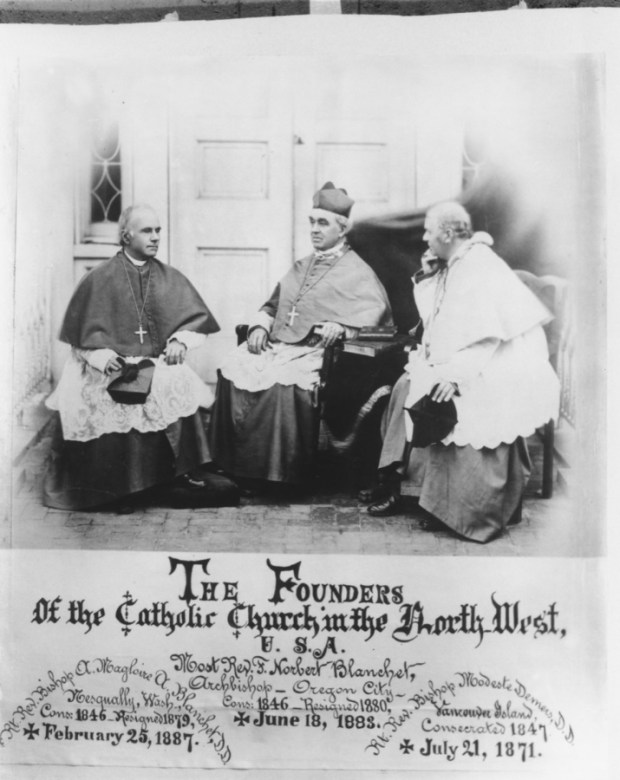
Two Blanchets and a Demers (image credit: The Columbian)
The wonderful Chinook Jargon lexicon by Demers, Blanchet, and Saint Onge (1871; data from as far back as 1838, when Demers and Blanchet arrived at the thriving Fort Vancouver community from eastern Canada) commonly uses both of these variants:
- pus — traceable back to Lower Chinookan
— defined as ‘for, if, when, in order to, that’
NOTE 1: Just as in the later Grand Ronde dialect, pus is used in DBS 1871 as ‘for’ + noun, as well as ‘for’ + verb.
NOTE 2: The only word for ‘when’ in DBS 1871 is pus, essentially the same as in the later Northern Dialect, but unlike Grand Ronde. - (A) spos (far more common than spus) / (B) spus (much rarer than spos) — both apparently due to (nautical? South Seas Pidgin-influenced?) English.
— undefined; both used as ‘when, if’;
IMPORTANT: Only one single occurrence has spos used as ‘in order to / that’ (p. 52): Leïop…iaka tiKeH spos tlaska masache, ‘The Devil…wants that they be evil.’
Compare these data with the 1820 published Chinuk Wawa vocabulary of Gabriel Franchère, where I find no word for ‘if; so that’, but ‘when’ is only expressed as < kantchick / kantchik >, and there are fewer European-derived words. For example, ‘salmon’ and ‘nose’ are still conveyed by the Indigenous words < equannet > and < ibikats > in 1820, whereas D-B-S 1871 [1838+] have < samon > and < nos >.
We might conclude that, some time after 1820 and before 1838…
…perhaps with the 1825 founding of Fort Vancouver, with its steady maritime communication with the rest of the world, primarily via English-speaking crews?…
…English took on a greater role in shaping CW than it had played in the earliest times.
(1794+ with Nootka Jargon being introduced to the lower Columbia River by US & UK mariners; 1811+ with the establishing of Fort Astoria by a US company.)
Bonus fact:
It’s remarkable how rare tlus + {pus / spos / spus} + verb is in D-B-S 1871. (I.e. to express ‘should; ought to; please do’, et cetera.)
I found only 1 occurrence with each of these 3 variant spellings!
From personal experience, I have the impression that this phrase is common in Grand Ronde dialect as well as in Northern Dialect; a check of Kamloops Wawa confirms this, and it’s not rare in the Indigenous letters written in the north.
So our łúsh-pus is apparently of comparatively recent vintage!
