1908 [1855], SW Oregon: A different SKOOKUM HOUSE
From early Settler days in southwest Oregon, specifically from the Rogue River War, comes a new meaning of “skookum house”.
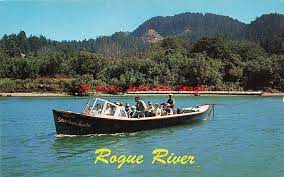
Postcard of Rogue River, Oregon mailboat “Skookum House” (image credit: ebay)
Apparently a fortress of the Native people involved in that conflict was well known as “Skookum House“, that is “the strong building” in Chinuk Wawa.
This is told to us in English without an article “the” in front of the phrase, so it sure looks like a proper name, not a common noun.
And this is a different, more literal, sense than Chinook Jargon’s familiar skúkum-hàws = ‘jail, prison’. In the ‘jail’ sense, I’m accustomed to hearing this phrase with the same stress pattern as in (other) compounds. I show that by placing a secondary (“grave”) stress mark on the haws.
I infer that the more literal Skookum House ‘strong building’ likely had the usual stress pattern of (other) Adjective + Noun phrases: skúkum háws, with the main stress being on the Noun.
You can see that we don’t use a dash in writing this newly found phrase. The hyphen is used when a Jargon expression has a meaning different from the combined literal meanings of its parts.
Here’s the newspaper article where I found the name Skookum House:

DEAD OF THE NORTHWEST
J. W. Wilkinson, Who Battled With
Indians in Early Days.GOLD BEACH, Or., Feb. 3 . — (Speclal.) —
J. W. Wilkinson, who died recently
at Port Orford, was born in Henry,
Echo County, Va., March 1, 1822, and
came to Curry County in the Spring of
1854. He settled near the mouth of
Rogue River, During the following year
occurred the memorable war between the
whites and the Rogue River Indians. Mr.
Wilkinson took part in this war. When
the attack was made on Ellensburg (now
Gold Beach), he and the greater part of
the other settlers found protection in a
fort constructed for that purpose on the
north side of the river. Their lives were
saved, but all else was lost. Following
this attack was one made on Skookum
House, the fort of the Indians, situated
about 15 miles up the river. This attack
was one of the best-planned and most
successfully executed of all recorded in
struggles between the two races, and the
power of the red men was completely
destroyed.
— from the Portland (OR) Morning Oregonian of February 4, 1908, page 8, column 6
Other sources back up this memory of a place known at the time as Skookum House. A 1909 newspaper discusses the 1855 “battle [of] Skookum House”.
There’s an entire history webpage about this battle, quoting a number of sources. It tells us that the Native people referred to both the Settlers’ and their own forts as Skookum Houses.
I’ve previously written about this “new” meaning of Skookum House, but I wanted to share all this corroborating data today!
