1879 [1853?]: A southwest Oregon “Indian war”
On the Rogue River of southwest Oregon, a Settler group heading to hunt gold in California has a violent run-in with tribal people.
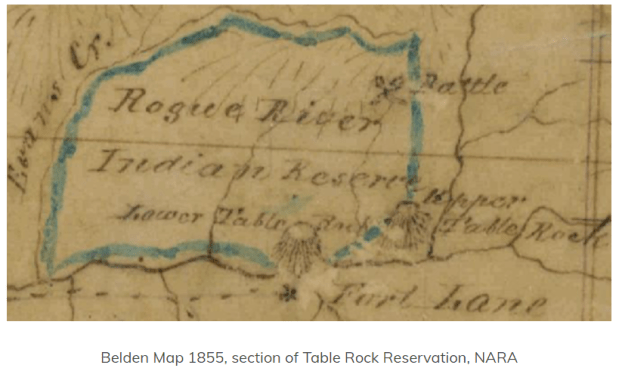
An outcome of the events told today (image credit: David Gene Lewis’s NDN History Research)
They’ve been deputized along the way by the US Army’s Phil Kearney, to help punish Native folks who have attacked and killed troops.
No less than the famous Joseph Lane narrates this recollection. (Lane Community College, which teaches Chinuk Wawa, is named for him.)
Lane was the presidentially appointed first governor of Oregon Territory. If he’s remembering correctly that the year was 1851, at the time of the incidents told below, he was O.T.’s representative-elect to the US Congress. But sources seem to agree that he’s actually talking about 1853, after being re-elected.
He already knew the tribe in question, having honored its chief’s request to bestow his own name “Joe” on the man (and to name other family members). This fact alone suggests the use of Chinuk Wawa, and we already know that the Hudsons Bay Company’s activities in that area brought the Jargon by the late 1820’s.
Lane explicitly quotes CW from his “war”.
Chief Joe’s wife Sallie asks Lane the name of the commanding officer:

I told her that the big “Tye“
was Kearney, a new man in this coun-
try, and that he was “hias sulax,” and
all the chiefs and warriors had better
come in and make peace…
That’s táyí ‘chief’ & hayas-sáliks ‘very-fierce’.
Soon after this, Lane speaks with Chief Joe himself:

I then opened a talk with Joe, and told
him that I was no longer a “Tye,” but
only a “tenas” man, and could do noth-
ing for him or the prisoners — that he
must come and bring his people with
him and make peace with the big sol-
dier “Tye.”
That’s a tənəs ‘small; minor’ man.
Sallie again has a word with Lane:

I told her that I
could do nothing with him-that he
was “hyas sulax,” (very mad), and that
I could do nothing with him. “But,”
said I, “I will overtake you at Yreka.
By that time, perhaps, his heart may be
good. If so, I will bring you all back
and give you up to your chief.”
The preceding bears clear signs of having been spoken entirely in Jargon.
Kearney takes the tribe’s women and children prisoner, but then releases them to Lane:

All things being settled, I
turned to Sallie and told her that the
“Soldier ‘Tye’ had agreed to send her
and her people back to their homes and
their people…
Soldier was a word of Jargon as well.
— from “Early Oregon History: The Indian War of 1851”, in the Albany (OR) State Rights Democrat of August 1, 1879, page 1, columns 4-7
