1894, Chelan, WA: A language now little used (alternate take)
The Chelan [šəlæn] Salish man known as Cultus Jim, in north-central Washington state, was evidently known for his clear expression of Indigenous land title, in Chinuk Wawa.

An optimistic assessment of Chinuk Wawa’s endangerment (image credit: Vanuatu Post)
We have at least 2 quotations of his sentiments. You can compare the first take with this second one:
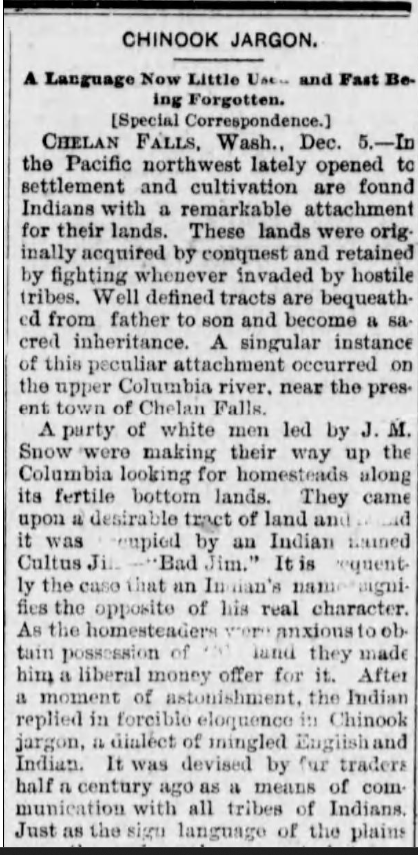

CHINOOK JARGON.
A Language Now Little Used and Fast Be-
ing Forgotten.[Special Correspondence.]
CHELAN FALLS, Wash., Dec. 5 . — In
the Pacific northwest lately opened to
settlement and cultivation are found
Indians with a remarkable attachment
for their lands. These lands were orig-
inally acquired by conquest and retained
by fighting whenever invaded by hostile
tribes. Well defined tracts are bequeath-
ed from father to son and become a sa-
cred inheritance. A singular instance
of this peculiar attachment occurred on
the upper Columbia river, near the pres-
ent town of Chelan Falls.A party of white men led by J. M.
Snow were making their way up the
Columbia looking for homesteads along
its fertile bottom lands. They came
upon a desirable tract of land and found
it was occupied by an Indian named
Cultus Jim — “Bad Jim.” It is frequent-
ly the case that an Indian’s name signi-
fies the opposite of his real character.
As the homesteaders were anxious to ob-
tain possession of the land they made
him a liberal money offer for it. After
a moment of astonishment, the Indian
replied in forcible eloquence in Chinook
jargon, a dialect of mingled Engiish and
Indian. It was devised by fur traders
half a century ago as a means of com-
munication with all tribes of Indians.
Just as the sign language of the plainswas the universal passport between
whites and Indians on the plains east of
the Rocky mountains, Chinook was the
language of trade and diplomacy, and
the Indians still use it in addressing a
white man.As Cultus Jim delivered his oratorical
reply, he emphasized it with native grace
of gesture, turning his face upward and
extending his armns to the sky when al-
luding to his father and grandfather in
the Indian elysium, or when appealing
to God, and downward when implying
his own perdition should he be false to
the trust of his fathers. His words were
emotional and passionate — a piece of In-
dian oratory rarely equaled in a lan-
guage now little used and fast being for-
gotten. Thus he spoke:“Mash nika illahe? Halo! Ankutty
nika papa mitlite; delate ankutty nika
grandpapa mitlite; alta nika mitlite, pe
alki nika mitlite. Nannitch six! Alki
nika memaloose pe clatawa sockalie.
Spose nika mitlite sockalie, wake lalie ict
man chaco, pe nika nannitch nika papa
pe yaka wa-wa Jim! Carter mika
mash mika illahie? Icta nika wa-wa?
Clonas halo wa-wa. Wake lalie, nika
grandpapa chaco pe yaka wa-wa Jim!
Carter mika mash okoke illahie? Wake
carter nika wa-wa, nike delate quash.
Nika papa pe grandpapa clatawa, pe
Sockalie Tyhee chaco. Spose yaka tika*
cumtux carter nika mash illahie, pe halo
nika wa-wa, okoke Tyhee wa-wa Jim!
Mika clatawa copa Lee Jamb. Halc
nika mash nika illahie.”Interpreted this means: “Sell my land?
No! A long time ago my father lived
here. A very long time ago my grand-
father lived here. Now I am here, and
by and by my children will live here.
See here, sir! By and by I shall die and
go up above. Suppose I am up above.
Before long a man comes, and I see that
it is my father, and he says, ‘Jim, why
did you sell your land? What can I
say to him? Nothing. Pretty soon my
grandfather comes, and he says the same
thing to me. I cannot answer him, for
I am now afraid. My father and grand-
father leave me and God comes to me.
If he asks me why I sold my land and I
cannot tell him, he will say, ‘Jim, you
must go down to hell.’ No, I will not
sell my land.” HERBERT HEYWOOD
— from the Ashland (OR) Valley Record of January 4, 1894, page 1, column 6
Bonus fact:
On the same page, in column 4, there’s another article, “Fools and Frolics”. It reports on the “Grand Masque Ball Given by Company D” of the Oregon National Guard.
A long list reveals who dressed in which costumes. Aside from the large number of “dude” costumes (a fashionable and funny word in the West at that time), I’m kind of charmed by the way Chinook Jargon occurs in it:
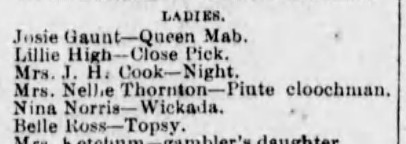
LADIES.
Josie Gaunt — Queen Mab.
Lillie High — Close Pick.
Mrs. J. H. Cook — Night.
Mrs. Nellle Thornton — Piute cloochman.
Nina Norris — Wickada.
Belle Ross — Topsy.
My first guess was that the first few include characters from Shakespeare; Queen Mab is one, for sure. I’ve given up on connecting the others to The Bard for now, though. “Close Pick” = “A good pick” 😁 “Piute cloochman” = “A Paiute woman”. “Wickada” = apparently “Can’t / No Way”.
