1910, Wenatchee, WA: Defining a gentle cayuse
A contradiction in terms, the way this article about Jargon & the courts tells it!
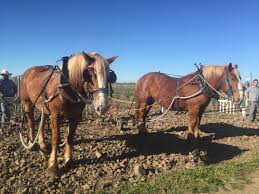
Gentle cayuses? (Image credit: Cayuse Vineyards – Horses, Rocks and a Crazy Frenchman)
Our post-frontier oxymoron clipping from north-central Washington State does a lovely job of conveying the issue, with a splash of genuine Northern Dialect Chinuk Wawa:
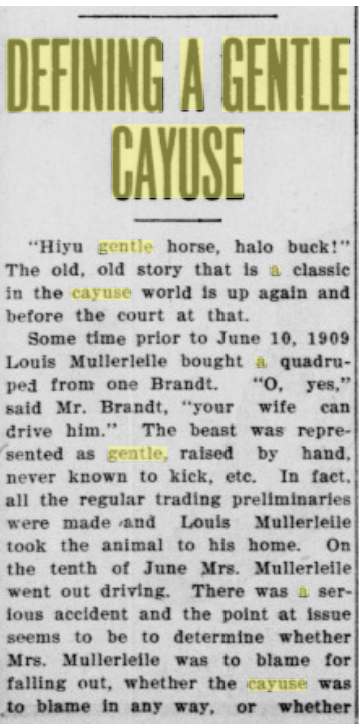

DEFINING A GENTLE
CAYUSE“Hiyu gentle horse, halo buck!”
The old, old story that is a classic
in the cayuse world is up again and
before the court at that.Some time prior to June 10, 1909
Louis Mullerleile bought a quadru-
ped from one Brandt. “O, yes,”
said Mr. Brandt, “your wife can
drive him.” The beast was repre-
sented as gentle, raised by hand,
never known to kick, etc. In fact.
all the regular trading preliminaries
were made and Louis Mullerleile
took the animal to his home. On
the tenth of June Mrs. Mullerleile
went out driving. There was a ser-
ious accident and the point at issue
seems to be to determine whether
Mrs. Mullerleile was to blame for
falling out, whether the cayuse was
to blame in any way, or whetherMr. Brandt misrepresented things.
It is certain that he sold a gentle
cayuse, or horse. So it only remains
to determine what he meant. When
the aboriginal Indian sells a cayuse
and says, “Hiu gentle, halo buck;
Klootchman all time wa-wa ride,”
he does not mean anything.Porter & Thomason are repre-
senting the plaintiffs and Reeves &
Reeves are working for the defense.It is a jury trial, the last one on
the calender [calendar] for this term. This has
been a light jury term, thouugh [though]
there are a few other civil cases.Those on the jury are: E. F.
Sprague, A. L. Mitchell, L. H. Mil-
lard, L. G. Mabie, J. H. Moss, W.
R. Cornell, J. O. Place, J. H. Gul-
let, J. B. Scott, W. E. Morton and
W. G. Mitchell.
— from the Wenatchee (WA) Daily World of April 14, 1910, page 1, columns 1 & 2
Comments:
“Hiu gentle, halo buck; Klootchman all time wa-wa ride”
= háyú djéntəl*, hílu bə́k*, łúchmən ál-tʰáym* wáwa Ráyd*
= ‘Very gentle, doesn’t buck; the wife is always asking to ride.’
- The lack of pronoun in reference to the horse strikes me more as a Settler stereotype of Native speech than of the actual thing, which would strongly prefer to call this animate being yaka ‘(s)he’.
- We have to consider, as linguist Edgar Schneider reminds us, that the Chinuk Wawa quote in this article appears to be “imagined speech”, an idealized portrayal, rather than an attempt at precise quotation.
- Nevertheless, hayu ‘much, many; a lot’ as an all-purpose intensifier is truly typical, it turns out, of the Northern Dialect.
- hilu as the general negator also typifies this dialect.
- Those asterisked* words* aren’t to be found in the 2012 Grand Ronde Tribes dictionary of (Southern Dialect) Jargon. “Gentle” and “buck” are new to me in a Jargon context, but they’re exactly what we expect in the post-frontier Northern Dialect, new loans from English that have more precise meanings than existing “Chinook” words had.
- “All time” sounds very much like the Chinese Pidgin English-style loans that we also find in the same time & space context, a more common one being “all same“.
- “Ride” is another such new borrowing, and in fact we have it documented several times in the Kamloops Wawa newspaper of that era.
Put it all together, and you have a very compelling, if not 100% factual, specimen of the Northern Dialect of Chinuk Wawa.
