1885, BC: The fish hatchery mystery
Can we bring forensic linguistics into a historical dispute? Let’s try!
Is this one of the Great Unsolved Mysteries of Canadian History? You decide!
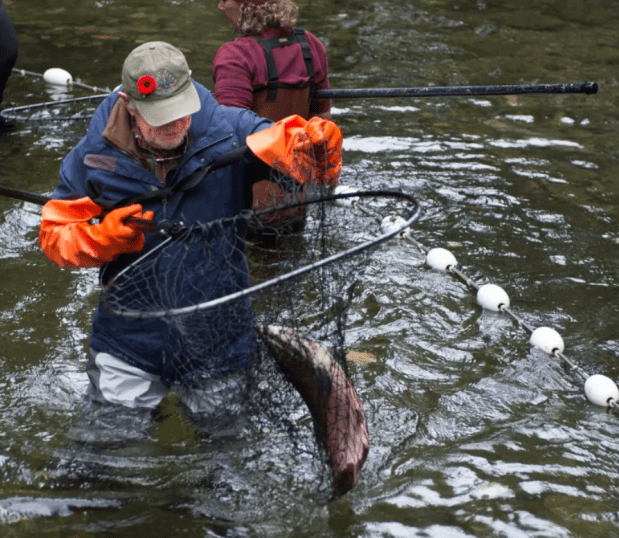
Goldstream Fish Hatchery, Victoria area (image credit: Golden Rods and Reels)
In the Victoria, British Columbia area in the late 1800s, one of the civic issues was the effectiveness of a fish hatchery.
One critic of the hatchery claimed that the hatchery had been failing to produce what were perceived as superior fish (sockeye or spring salmon), instead over-producing the supposedly inferior white salmon.
The Settler accuser claimed that the Native employees of the hatchery could tell the difference between the various salmon species’ eggs, and that they loudly commented on that fact in Chinook Jargon.
Let’s examine this.
…
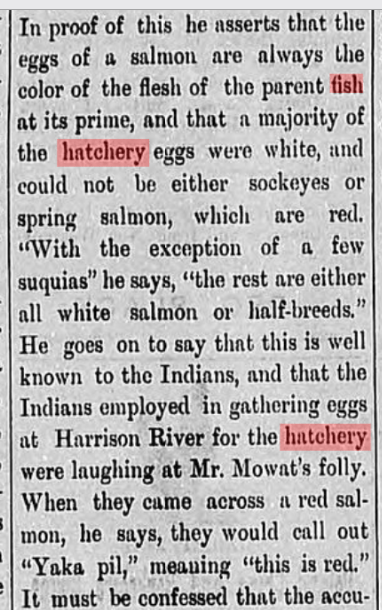
In proof of this he asserts that the
eggs of a salmon are always the
color of the flesh of the parent fish
at its prime, and that a majority of
the hatchery eggs were white, and
could not be either sockeyes or
spring salmon, which are red.
“With the exception of a few
suquias” he says, “the rest are either
all white salmon or half-breeds.”
He goes on to say that this is well
known to the Indians, and that the
Indians employed in gathering eggs
at Harrison River for the hatchery
were laughing at Mr. Mowat’s folly.
When they came across a red sal-
mon, he says, they would call out
“Yaka pil,” meaning “this is red.”…
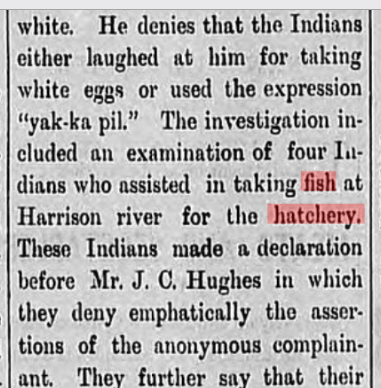
He denies that the Indians
either laughed at him for taking
white eggs or used the expression
“yak-ka pil.” The investigation in-
cluded an examination of four In-
dians who assisted in taking fish at
Harrison river for the hatchery.
These Indians made a declaration
before Mr. J. C. Hughes in which
they deny emphatically the asser-
tions of the anonymous complain-
ant.
— from the Victoria (BC) British Columbian of September 12, 1885, page 2, columns 1 & 2
Now, if we think about this, yaka pil actually means ‘(s)he is red’ — referring to an animate, individuated being. Sometimes, Jargon speakers even use yaka in plural reference, but again, this would be a ‘they’ that indicates a separate, mobile entity.
You see what I’m saying? Yaka would indicate fishes, not their eggs.
However, Settlers are the one cultural group who we’ve found time and again use yaka as if it meant ‘it’ or ‘this’!
The most probable analysis of the “quotation” in Jargon supplied by the accusing party is, it was concocted by that Settler, to further his own goals.
And fellow Settlers were fairly likely to accept his claim. They spoke a similar style of Jargon, on the average — the accuser’s words would sound plausible to them. And “everyone knew”, that is, most Whites at that time & place stereotyped, Indigenous people as speaking Chinook Jargon.
So the evidence indicates that the supposed quotation of authoritative Natives is phony.
(It follows from this that we don’t want to take this “yaka pil” as being valid data on how Chinuk Wawa has been spoken. Nor should we copy this way of speaking.)
Bonus fact:
That word suquias in today’s clipping must come from a local Salish language, such as Lekwungen or SENCOTEN. We linguists find it useful to group these languages under a macro-language, (Northern) Straits Salish, so I peeked into a couple of giant dictionaries of different flavors of (N)SS. So far, I haven’t tracked down any likely match for this word, so it remains a delightful mystery. It may even be a newly discovered word of that language!
