1858: Grand Ronde/French Prairie Métis talking Chinook Jargon
Truly a gem — Chinuk Wawa words of a Grand Ronde-area Métis, in the early reservation era!

Champoeg village in 1851 (image credit: Oregon Encyclopedia)
The quotations below have to be at least partly fictional, with the writer portraying the Jargon speaker as a hapless yokel of another race from himself. (The guy can’t count to 4? Really?!)
But for all that, it’s remarkable how excellent the Chinooking is here, and how true it is to the Southern Dialect of that era. The “I’m just spelling it like I hear it” spellings are typically a fine indicator of actual knowledge of Jargon, besides the top-notch grammar.
Looks like even when it was a Settler quoting a Native person, at this place and time the quoting had to be accurate in style, as just about everybody knew real good Jargon. See how no English translation is provided? Folks would’ve laughed you out of town if you printed poor Chinuk Wawa in the 1850s Willamette Valley of Oregon.
And take notice, there seems to be some accurate Native culture documentation here, as with the thing about using twisted hazel to tie things up.
Ah, yeah, also, one point of the following article is a humorous political commentary on “Bushites” and the “Salem clique” in Oregon Territory’s capital town.
Read and delight in this amazing document. I’ll add my usual 2¢ afterwards…
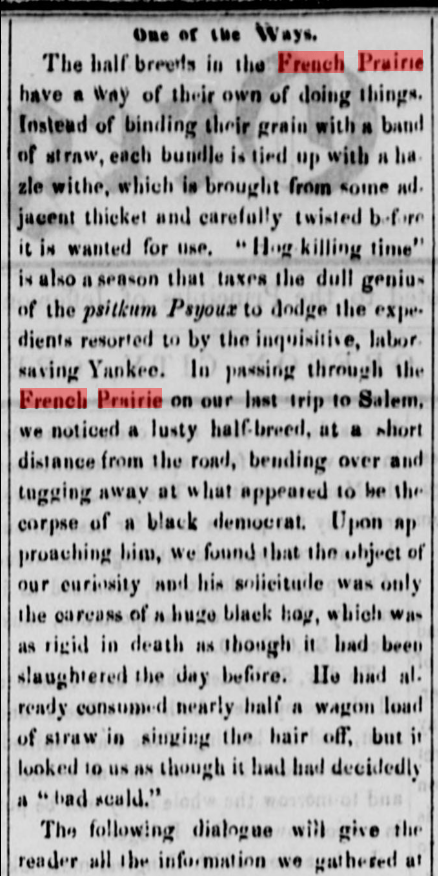

One of the Ways.
The half breeds in the French Prairie have a way of their own of doing things. Instead of binding their grain with a band of straw, each bundle is tied up with a hazle [hazel] withe, which is brought from some adjacent thicket and carefully twisted before it is wanted for use. “Hog killing time” is also a season that taxes the dull genius of the psitkum Psyoux to dodge the expedients resorted to by the inquisitive, labor-saving Yankee. In passing through the French Prairie on our last trip to Salem, we noticed a lusty half-breed, at a short distance from the road, bending over and tugging away at what appeared to be the corpse of a black democrat. Upon approaching him, we found that the object of our curiosity and his solicitude was only the carcass of a huge black hog, which was as rigid in death as though it had been slaughtered the day before. He had already consumed nearly half a wagon load of straw in sing[e]ing the hair off, but it looked to us as though it had had decidedly a “bad scald.”
The following dialogue will give the reader all the information we gathered at the time regarding the reason for the half-breed modus operandi of making bacon:
Copa nica [‘From Me’, the pen name of a regular correspondent to this newspaper] –– Halloo, old fellow! is that one of the unwashed?
Psyoux — Wake cumtux.
Copa — I say, is that the corpse of a bushite ?
Psyoux — Wake nica cumtux.
C . — Clonas okoke Salem tillicum mica mimaluse ?
P. (looking up much surprised, and open-ing a mouth which favored that of a huge catfish) — Wake tillicum! Cushaw okoke!
C . — Clonas mica climnawhit.
P . — Wake climnawhit nica; mica nanage ?
C . — Nowwitka, nica nanage kawqua Salem tillicum ; spose mimalused.
P. (taking hold of one of the fore legs of the hog, and directing our attention to it by gesturing with the other hand) — Close mica nanage! Tillicum moxt te-ow-it-wake klone !
C . — Ah! chee nica nanage te-ow-it. Lateet kawqua bushite. Clai-hai-um, six.
Comments:
- psitkum Psyoux
= sítkum pʰasáyuks, literally ‘half French’, a new expression to us but obviously meaning someone from the fur-trade-connected ‘Métis’ community of the Willamette Valley. - The dialogue:
Psyoux — Wake cumtux.
‘Dunno.’
= wík kə́mtəks.
Copa — I say, is that the corpse of a bushite ?
Psyoux — Wake nica cumtux.
= wík nayka kə́mtəks.
‘I don’t understand.’C . — Clonas okoke Salem tillicum mica mimaluse?
= t’łúnas úkuk séyləm*-tílixam mayka míməlus?
‘That must be a Salem fella that you’ve killed?’P. — Wake tillicum! Cushaw okoke!
= wík tílixam! kúshu úkuk!
‘It’s not a person! This is a hog!’C . — Clonas mica climnawhit.
= t’łúnas mayka t’łəmíxnwət.
‘You gotta be kidding.’P . — Wake climnawhit nica; mica nanage?
= wík t’łəmínxwət náyka; mayka nánich?
‘I’m not kidding; can you see?’C . — Nowwitka, nica nanage kawqua Salem tillicum; spose mimalused.
= nawítka, nayka nánich kákwa séyləm*-tílixam, spus míməlust.
‘Sure, I can see it’s like a Salem fella, when he’s dead.’P. — Close mica nanage! Tillicum moxt te-ow-it-wake klone!
= łúsh mayka nánich! tílixam mákwst-tiyáʔwit, wík łún!
‘You need to take a good look! People are two-legged, not three!’C . — Ah! chee nica nanage te-ow-it. Lateet kawqua bushite. Clai-hai-um, six.
= á*! chxí nayka nánich tiyáʔwit. latét kákwa bə́shayt*. łax̣áyam, síks.
‘Ah! Now I’m seeing the legs. It’s the head that’s like a Bushite. See ya, pal.’
That’s real, real good Jargon.
I’m fascinated by the tiny detail of the spellings mimaluse & mimalused. They seem to reflect the two known pronunciations of the word for ‘dead’ (and here ‘kill’, which is normally mamuk-míməlus(t) / modern munk-míməlus(t)). Of course the spelling mimalused makes it look like an English past tense ~ passive form…and we do find this word loaned into regional English and inflected that way. Hmmm.

That’s a truly great find, Dave. The Jargon looks absolutely authentic and well in keeping with the language as recorded from later generations of Grand Ronde community speakers. The rolls of the Grand Ronde community show quite a few French surnames, and most of those families came through French Prairie on their way to the reservation. I don’t have exact numbers in hand, but I believe that most of these families moved to the reservation some time following its initial founding in 1856. They moved in to join Native-side relatives. Some, though not all, were granted formal adoption by the Indian community. Formally adopted or not, all were part of the local community.
So we’re accumulating some authentic contemporary samples of the language in use during the reservation era. There is quite a good sample in the petition from St Michaels Mission to canonize Kateri Tekakwitha – probably written by the priest as David Lewis observed (tho not unlikely that he would have asked for help from some of his parishioners, many of whom bore French surnames) but he used the language in that community so that counts!
LikeLiked by 1 person
Pingback: 1872: “Letter written by an Indian Chief” at Grand Ronde | Chinook Jargon